A Developer's Guide to Vascular Dementia ICD 10 Codes
 James Park, MS
When we talk about vascular dementia in ICD-10, the go-to code is often F01.50. This code represents vascular dementia of unspecified severity, without behavioral disturbance, psychotic disturbance, mood disturbance, or anxiety. Getting this code and its related F01-family counterparts right is absolutely crucial for everything from clinical documentation and billing to robust research.
Quick Reference for Vascular Dementia ICD 10 Codes
For those of us working as healthcare data engineers or clinical researchers, being able to nail down the correct ICD-10-CM code for vascular dementia is the first, non-negotiable step in any data analysis or ETL pipeline. A precise code is the foundation for defining patient cohorts accurately, which in turn leads to insights you can actually trust. This guide serves as a quick lookup for the core F01 codes, mapping them directly to their standard OMOP Concept IDs.
Essential Mapping for Data Professionals
Translating these source codes into a standardized vocabulary like SNOMED CT within the OMOP Common Data Model is the real key to unlocking network research. It’s this translation that allows disparate datasets from different healthcare systems to be harmonized and analyzed as a cohesive whole.
Below is a quick reference table I've put together that connects the most common F01.* codes to their official descriptions and, most importantly, their corresponding standard OMOP Concept IDs.
ICD-10-CM to OMOP Concept ID Mapping for Vascular Dementia (F01)
| ICD-10-CM Code | Official Description | OMOP Source Concept ID | Standard OMOP Concept ID (SNOMED CT) |
|---|---|---|---|
| F01.50 | Vascular dementia, unspecified | 26732 | 436949 |
| F01.51 | Vascular dementia with behavioral disturbance | 26640 | 436949 |
| F01.A0 | Vascular dementia, mild | 45768853 | 436949 |
| F01.A1 | Vascular dementia, mild, with behavioral disturbance | 45768854 | 436949 |
| F01.B0 | Vascular dementia, moderate | 45768855 | 436949 |
| F01.B1 | Vascular dementia, moderate, with behavioral disturbance | 45768856 | 436949 |
| F01.C0 | Vascular dementia, severe | 45768857 | 436949 |
| F01.C1 | Vascular dementia, severe, with behavioral disturbance | 45768858 | 436949 |
As you can see, while the source ICD-10-CM codes are highly specific about severity and behavioral disturbances, they all map to the same standard SNOMED CT concept (436949 for Vascular dementia). This is a critical detail for anyone building analytical queries.
Tip for OMOP Users: A word of advice from experience-always build your queries to join on the standard concept ID, not the source concept ID. This single practice ensures your analysis is comprehensive and captures all relevant patient data, no matter how it was originally coded. If you ever need to double-check a mapping, the OMOPHub Concept Lookup tool is an invaluable resource.
Understanding the Clinical Nuances of the F01 Codes
Before we get into the technical side of SQL queries and data models, it’s crucial to grasp the clinical reality behind the F01 code series. For data professionals, this context is what gives meaning to the records we manage. Vascular dementia is a form of major neurocognitive disorder that stems from reduced blood flow to the brain, a process that damages and ultimately destroys brain cells.
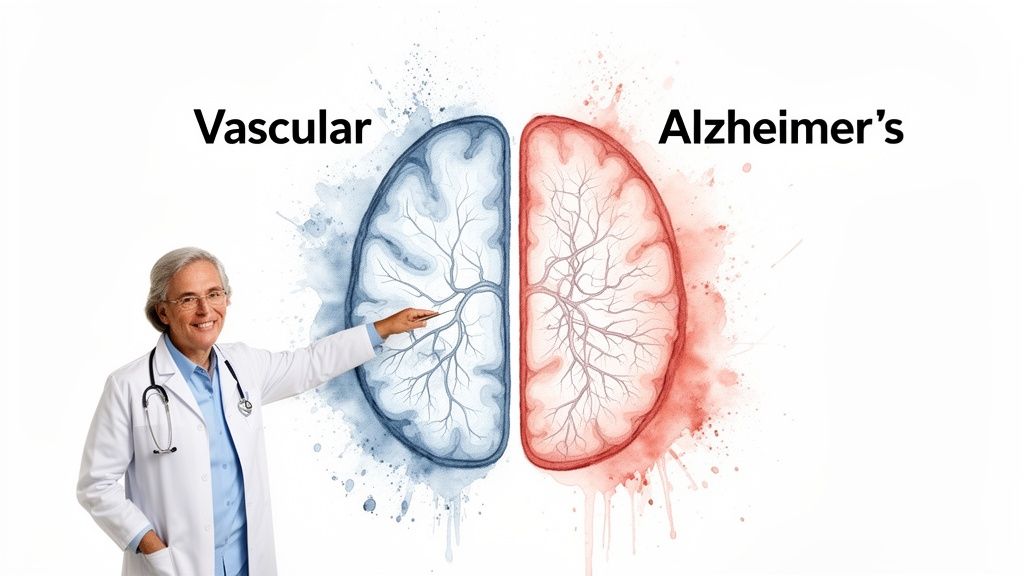
This isn't the same as Alzheimer's disease, which is characterized by the buildup of plaques and tangles. Instead, vascular dementia is the direct result of cerebrovascular problems-think strokes or chronic conditions that weaken circulation. This distinction is absolutely critical for both patient care and research, as the treatments, risk factors, and prognoses are entirely different.
The Real-World Impact of Precise Coding
The vascular dementia ICD 10 codes (the F01 family) are far more than just billing artifacts; they are foundational to public health surveillance and research. When coding is done right, it empowers healthcare systems to:
- Track Prevalence: Accurately monitor the incidence and spread of the disease, which is essential for allocating resources where they're needed most.
- Support Research: Help researchers pinpoint specific patient cohorts for clinical trials and large-scale epidemiological studies.
- Inform Policy: Deliver the reliable data that public health officials need to build effective prevention and management strategies.
Vascular dementia (VaD) places a heavy burden on global health systems, one that our data infrastructure must be able to represent accurately. Around 8.5 million people worldwide live with pure vascular dementia, and another 9.1 million have mixed dementia. These numbers hint at the clinical complexity that our IT systems need to capture with correct ICD-10 coding. Making matters more urgent, projections show this burden could swell to 42.7 million cases by 2050. You can review the complete data in the World Stroke Organization's fact sheet.
A Note for Data Professionals
When you're working with F01 codes, always remember the clinical story they tell. A single code can dictate a patient's entire care pathway and their eligibility for groundbreaking research.
For developers just getting started with the OMOP Common Data Model, digging into the official documentation is the best way to understand how these vocabularies are structured. A great place to start is the
https://docs.omophub.comportal.
This foundational knowledge ensures that the data pipelines and analytical tools you build genuinely reflect the clinical landscape. Ultimately, that precision contributes to better patient outcomes and more powerful research.
A Detailed Breakdown of the F01 Code Family
To work with data on vascular dementia, you have to get familiar with the specifics of the F01 code family. This isn't a single, catch-all code. It’s a group of related codes designed to capture the clinical details of a patient's condition, especially its severity and any related behavioral issues. Nailing the right code is the first step toward sound data collection and analysis.
The parent code, F01, is the starting point, indicating dementia caused by cerebrovascular disease. From there, the characters that follow add crucial layers of detail. The fifth character specifies severity-A for mild, B for moderate, and C for severe-while the sixth tells you if behavioral, psychotic, or mood disturbances are present. That level of detail is exactly what you need to build precise patient cohorts for clinical research.
Decoding the Subcategories
Each code in the F01 family has a specific job, letting clinicians paint a very precise picture of a patient's condition. For those of us on the data side-ETL developers and analysts-understanding these differences is key to building meaningful logic into our data pipelines.
Here’s a practical breakdown of how the codes differ:
- F01.5 - Unspecified Severity: This is your go-to when the medical record just doesn't specify how severe the vascular dementia is. It splits into F01.50 (without behavioral issues) and F01.51 (with behavioral issues).
- F01.A - Mild Severity: You’ll use this when the condition is explicitly documented as mild. The codes are F01.A0 (no disturbances) and F01.A1 (with disturbances).
- F01.B - Moderate Severity: This is for clear-cut cases of moderate vascular dementia, broken down into F01.B0 (no disturbances) and F01.B1 (with disturbances).
- F01.C - Severe Severity: This is reserved for the most advanced cases. The codes are F01.C0 (no disturbances) and F01.C1 (with disturbances).
Critical Coding Guidelines and Notes
The official ICD-10-CM guidelines aren't just suggestions; they provide critical context that dictates how these codes should be applied. Overlooking these rules is a fast track to inaccurate data and, ultimately, flawed research. If you're building data validation rules or defining a study cohort, pay very close attention.
Important Note: A key directive for the F01 family is the Excludes1 note for F06.7- Mild neurocognitive disorder due to known physiological condition. In simple terms, this means you can't code both conditions for the same patient. F01 represents a major neurocognitive disorder, which is a different clinical entity from a mild one.
There are also "Code also" instructions to consider. The guidelines require you to first code the underlying cerebrovascular disease (from the I60-I69 range). This establishes the crucial causal link between the vascular event and the resulting dementia in the patient's record.
Tips for Data Professionals:
- When you’re building a cohort based on F01 codes, always cross-reference with the I60-I69 codes to confirm the presence of the underlying cerebrovascular disease. It’s a great validation check.
- You can access these coding rules and relationships programmatically using the OMOPHub SDKs, which are available for both Python and R.
- For more in-depth guidance on setting up robust data pipelines, the documentation at
https://docs.omophub.comis an excellent resource.
Mapping ICD-10 to OMOP Standard Vocabularies
When you're working with the OMOP Common Data Model (CDM), one of the most critical steps is translating source codes-like the vascular dementia ICD-10 codes-into a standardized vocabulary. This isn't just a technical box to check; it’s the entire foundation for large-scale, federated research. It ensures that a diagnosis recorded in one hospital system means the exact same thing as a diagnosis in another, even if they started with different local codes.
The basic idea is to map a source concept, such as an ICD-10-CM code, to a standard concept, which is almost always from SNOMED CT. In your OMOP CDM instance, the raw data will hold the source_concept_id, but your analytical queries should be built around the standardized concept_id. This is a non-negotiable best practice for reliable analysis.
This hierarchy diagram gives you a clear visual breakdown of the F01 codes and how they branch into more specific diagnoses.
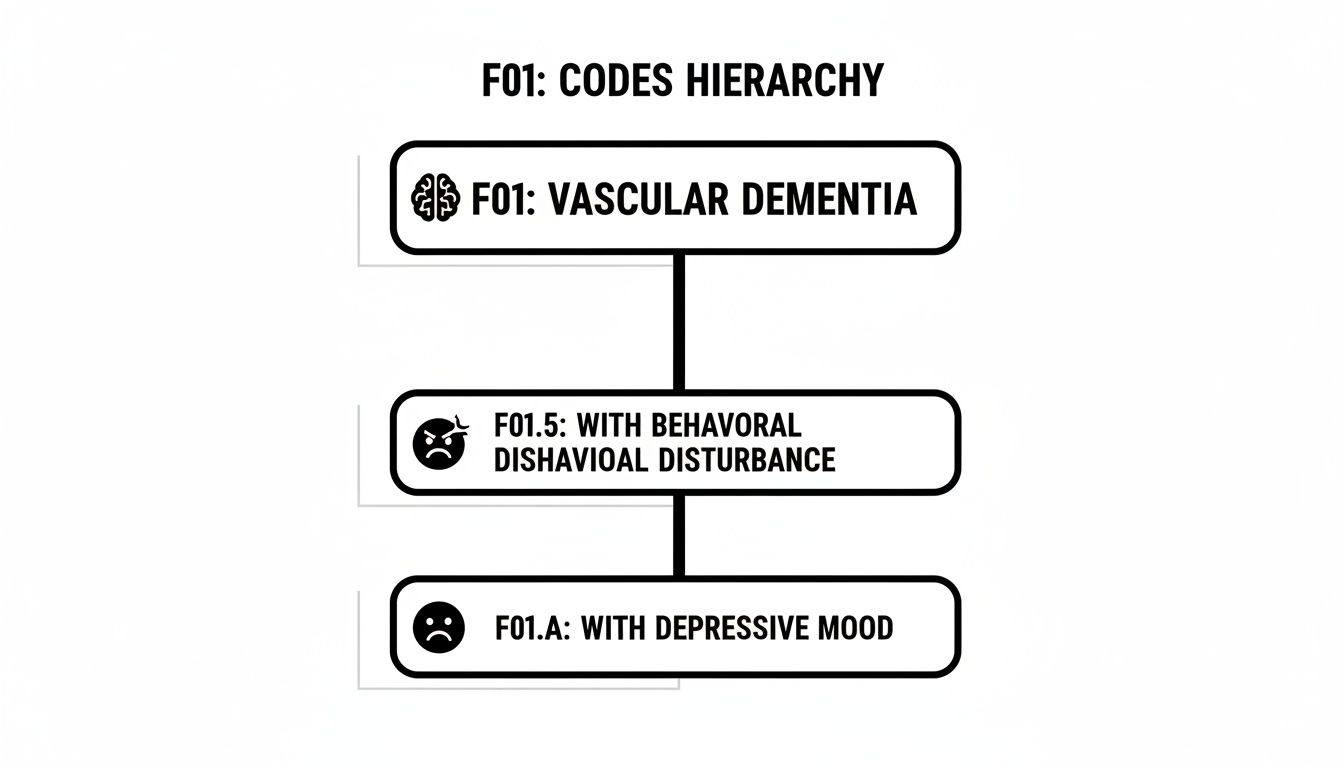
As you can see, F01 acts as the parent concept. From there, coders can specify much more clinical detail with subcategories like F01.5 (with behavioral disturbance) or F01.A (with depressive mood), which is essential for building nuanced patient cohorts.
Verifying Mappings and Best Practices
Double-checking these mappings is absolutely essential for data integrity in your ETL pipeline. A single incorrect mapping can silently exclude entire groups of patients from your research cohorts, which can completely skew your analytical results. Don't underestimate how much damage a bad mapping can do.
For developers and data managers, the OMOPHub Concept Lookup tool at https://omophub.com/tools/concept-lookup is a lifesaver. You can use it to instantly confirm how any vascular dementia ICD-10 code maps to its standard SNOMED CT counterpart. It's a great way to validate your ETL logic before you run a massive data load.
And if you’re grappling with older datasets, you might find our guide on ICD-10 to ICD-9 conversion helpful for understanding the challenges of mapping historical data.
Mapping Tips:
- Prioritize Standard Concepts, Always: Your analytical queries and cohort definitions should exclusively use standard concept IDs. Never build them on source IDs.
- Consult Vocabulary Documentation: Use resources like
https://docs.omophub.comto get a firm grasp on the relationships and structures within the standard vocabularies. - Automate with SDKs: If you need programmatic access, the OMOPHub Python SDK and R SDK are perfect for fetching concept mappings dynamically right within your code.
Practical Cohort Building with SQL in an OMOP CDM
Theory is one thing, but putting it into practice is where the real work begins. For anyone working with the OMOP Common Data Model (CDM), one of the most fundamental tasks is building an accurate patient cohort. When you need to identify a specific group-say, everyone diagnosed with vascular dementia-a well-crafted SQL query is your most essential tool.
The goal is to query the OMOP CDM for patients with the right condition records. Instead of hunting for a specific vascular dementia ICD 10 source code, the right way to do this is by working with the standardized vocabulary hierarchy. This is how you ensure you find every patient with the condition, no matter which source code was originally used to record their diagnosis. If you need a refresher on the model's structure, our detailed guide on the OMOP data model is a great place to start.
Writing the SQL Query
To build a truly comprehensive cohort, you'll need to join a few key tables within the CDM. The most important ones for this job are CONDITION_OCCURRENCE, CONCEPT, and CONCEPT_ANCESTOR. This three-table join lets you track down all descendant concepts of a high-level condition, which is the secret to building a complete and accurate patient list.
Here’s a practical SQL example that does exactly that-it finds all patients with any diagnosis of vascular dementia.
-- Find all patients with a diagnosis of Vascular Dementia
-- by using the CONCEPT_ANCESTOR table to find all descendant concepts

SELECT DISTINCT
    co.person_id
FROM
    condition_occurrence AS co
JOIN
    concept_ancestor AS ca ON co.condition_concept_id = ca.descendant_concept_id
WHERE
    ca.ancestor_concept_id = 436949; -- Standard Concept ID for 'Vascular dementia'
This query starts with the standard concept_id for "Vascular dementia," which is 436949. It then uses the CONCEPT_ANCESTOR table to find every patient record whose condition maps back to this concept or any of its more specific children.
Key Insight: Look closely at the
WHEREclause. It uses the standardancestor_concept_id, not a sourceconcept_id. This is the single most important principle for building robust, reproducible cohorts in an OMOP environment. It makes your analysis completely independent of the specific source codes used at different hospitals or clinics.
Tips for Optimizing Cohort Queries
Writing a good query is just the first step. You also have to make sure it runs efficiently and accurately, which is especially critical when you're dealing with massive datasets.
- Index Key Columns: Make sure the columns you're joining on are indexed. Columns like
condition_concept_id,descendant_concept_id,ancestor_concept_id, andperson_idare prime candidates and indexing them will make your queries run dramatically faster. - Use
DISTINCT: You'll noticeSELECT DISTINCTin the example. This is crucial because it prevents you from counting the same patient multiple times if they happen to have several relevant diagnoses in their record. - Validate Your Concept ID: Before running your query, always double-check that you have the right
concept_id. A reliable vocabulary tool like the OMOPHub Concept Lookup is perfect for this.
For more complex scenarios or if you prefer to build cohorts programmatically, you can find great examples in the official documentation at https://docs.omophub.com. And if you're working in a scripting environment, the OMOPHub SDKs for Python and R can help automate these lookups right inside your code.
Avoiding Common Coding and Data Quality Pitfalls
When you're building a dataset for vascular dementia research, accuracy is everything. It all starts with avoiding the simple, yet surprisingly common, mistakes in coding and data processing that can derail a study before it even begins.
One of the biggest hurdles I see is the confusion between the specific vascular dementia ICD-10 code, F01, and its much broader cousins like F03 (Unspecified dementia) or even G30 (Alzheimer's disease). Reaching for a non-specific code might seem harmless, but it severely compromises data quality. It makes isolating a true vascular dementia cohort nearly impossible.
This lack of specificity creates a ripple effect downstream. Your research findings get diluted by including patients with different dementia types, the true prevalence rates become obscured, and patient outcomes are misrepresented. In the end, sloppy coding leads to flawed analytics and shaky conclusions-a frustrating waste of time and resources.
Actionable Tips for Data Validation
The real-world stakes for getting this right are high. Just look at the data: mortality from hypertension-related vascular dementia in the U.S. skyrocketed from 7.873 to 26.246 deaths per 100,000 between 2005 and 2020. This sobering fact alone underscores why clean, precise data is not just an academic exercise.
At its core, solid ICD-10 education is the bedrock of good coding. It ensures clinicians and coders are on the same page, preventing data quality headaches from the start. For a deeper dive into standardizing these complex clinical concepts, our guide on https://omophub.com/blog/semantic-mapping offers valuable context.
To keep your analytical dataset clean, here are a few validation and cleaning tips to build directly into your ETL process:
-
Implement Rule-Based Validation: Create a simple rule to flag any record coded with F03 where a diagnosis for a cerebrovascular condition (codes I60-I69) is also present. This is a strong signal that a more specific F01 code might be the correct one.
-
Verify Your Concepts: Make it a habit to use a tool like the OMOPHub Concept Lookup. It's a quick way to double-check the mappings between your source ICD-10 codes and the standard OMOP concepts you're using for analysis.
-
Run Automated Checks: The OMOPHub SDKs for Python or R are perfect for this. You can write scripts to programmatically scan for logical inconsistencies, like a patient having conflicting dementia diagnoses within the same encounter. You can find more details in the official documentation at
https://docs.omophub.com.
F01 Coding: Your Common Questions Answered
When it comes to coding for vascular dementia, even experienced data professionals and clinicians run into the same handful of tricky questions. Let's break down some of the most common issues to clarify code distinctions, handle complex patient scenarios, and query data accurately within the OMOP Common Data Model.
What's the Real Difference Between ICD-10 Codes F01 and F03?
The critical distinction here is all about specificity. The vascular dementia ICD-10 code, F01, should only be used when there's solid clinical evidence that a patient's cognitive decline stems directly from cerebrovascular disease.
On the other hand, F03 is for Unspecified Dementia. Think of it as a temporary placeholder when the underlying cause hasn't been pinned down yet. From a data integrity standpoint, this matters immensely. In an OMOP CDM, these two codes map to completely different standard concepts, so using the wrong one can easily lead to patients being incorrectly included or excluded from a research cohort.
How Should I Code for Mixed Dementia with Both Vascular and Alzheimer's Components?
This is a classic coding challenge. When a patient presents with mixed dementia-showing signs of both vascular and Alzheimer's pathologies-the official ICD-10-CM guidelines are clear. You need to use codes for both conditions, but the sequence is key.
Always list the Alzheimer's disease code (G30.-) first, followed by the appropriate vascular dementia code from the F01 series. Within the OMOP CDM, this translates into two distinct entries in the CONDITION_OCCURRENCE table for the same visit. This structure is incredibly useful because it allows researchers to pinpoint and analyze this complex patient population without losing any of that crucial clinical nuance.
What's the Best Way to Query All Vascular Dementia Codes in the OMOP CDM?
The most robust and reliable method is to lean on the standard concept hierarchy. Don't fall into the trap of trying to manually list out every possible source code.
- Start by finding the high-level SNOMED CT concept for "Vascular dementia." A tool like the OMOPHub Concept Lookup makes this easy; the standard concept ID you're looking for is 436949.
- From there, build a SQL query that joins to the
CONCEPT_ANCESTORtable. By selecting alldescendant_concept_idrecords where theancestor_concept_idis 436949, you can construct a complete and accurate patient cohort.
This approach ensures you capture everyone who should be in your group, regardless of the specific source code that was originally used. For more in-depth examples, you can find detailed guidance over at https://docs.omophub.com.
Why Is My SQL Query for F01.50 Coming Up Empty?
This is a very common snag for people new to OMOP. The problem is almost always querying the condition_concept_id column with a source concept ID. Remember, best practice in OMOP is to always use standard concept IDs for your analytical queries.
Your ETL pipeline is responsible for mapping the source code F01.50 to its standard SNOMED CT equivalent, which then populates the condition_concept_id. To get your query working, simply target the standard concept ID (436949) instead. If you're looking to automate this mapping, the OMOPHub SDKs for Python and R are great resources.
Stop wrestling with healthcare vocabulary management. With OMOPHub, your team gets instant, compliant API access to OHDSI ATHENA, making it possible to build accurate data pipelines and run analytics faster. See how the platform can help at https://omophub.com.