A Guide to Your Medical Terminology Course
 Michael Rodriguez, PhD
Think of a medical terminology course not as a list of words to memorize, but as learning the fundamental grammar of medicine. It's a structured program that teaches you how to deconstruct complex clinical terms into their basic parts-prefixes, root words, and suffixes-so you can understand their precise meaning. It's about learning the "source code" of healthcare to ensure clear communication and accurate data handling.
Why Medical Terminology Is Your Secret Weapon

It’s easy to dismiss a medical terminology course as just another vocabulary builder, but that completely misses the point. A better analogy is learning the syntax of a programming language. If you don't get the rules, structure, and logic, you're just staring at lines of code, unable to spot bugs or understand what’s actually happening. It's the exact same with healthcare data.
This structured language, built mostly from Greek and Latin parts, forms the very backbone of all clinical documentation. Every single diagnosis, procedure, and observation is captured using this precise system. For anyone working with this data-from data engineers to clinical researchers-this foundation isn't just helpful; it's non-negotiable. One misinterpreted term can corrupt an entire dataset, torpedo an analysis, or introduce critical errors into an ETL (Extract, Transform, Load) pipeline.
The Building Blocks of Medical Language
To really get a handle on this, you have to understand how the terms themselves are built. This systematic approach is the key, as it lets you confidently break down and interpret words you’ve never even encountered before.
Here's a quick overview of how medical terms are constructed to convey precise clinical meaning.
The Building Blocks of Medical Language
| Component | Function | Example |
|---|---|---|
| Root Word | The core meaning, often pointing to a body part or system. | Cardi (heart) |
| Prefix | Added to the beginning to change the root's meaning. | Brady- (slow) |
| Suffix | Added to the end to describe a condition or procedure. | -itis (inflammation) |
Once you see how these pieces fit together, the logic becomes clear. For example, combining Brady- + Cardi gives you Bradycardia, which immediately tells you it's a condition involving a slow heart. In the same way, Carditis is unmistakably an inflammation of the heart. This logical structure is designed to eliminate ambiguity.
From Words to Standardized Vocabularies
While understanding these building blocks is the first step, modern healthcare data operates on a whole other level: standardized vocabularies. Think of these as massive, controlled dictionaries that ensure every hospital, clinic, and research institution is speaking the same digital language.
A strong grasp of terminology is the entry ticket to working with critical systems like SNOMED CT (Systematized Nomenclature of Medicine–Clinical Terms) and RxNorm. These vocabularies are the digital foundation of health IT, powering everything from accurate billing to advanced clinical analytics.
The link between terminology proficiency and professional competence is well-documented. One detailed study of nursing students, for instance, found an overall 75% accuracy rate on a specialized terminology test, with higher scores directly correlating to better academic performance. This just goes to show that a solid command of medical language is a reliable indicator of success in the field.
Beyond the technical applications, this skill becomes invaluable when you're faced with the task of translating complex medical terms for different audiences or into other languages. That ability to maintain clarity and precision is what truly makes a medical terminology course your secret weapon in any data-focused healthcare role.
What a Modern Course Syllabus Actually Covers
Forget the old-school approach of memorizing a medical dictionary. A modern terminology course built for data professionals is a different beast entirely. It’s less about rote learning and more about building a mental framework to see how clinical language becomes actionable data. The real goal is to understand the why behind the words, not just the what.
The tour always starts with the basic mechanics of the language itself. Before you can make sense of a complex diagnosis buried in a clinical note, you have to learn how to break it down. Understanding how prefixes, suffixes, and root words fit together is the key that unlocks everything else. This first step gives you the tools to deconstruct unfamiliar terms on the fly-a skill you’ll use constantly.
Building Knowledge From the Ground Up
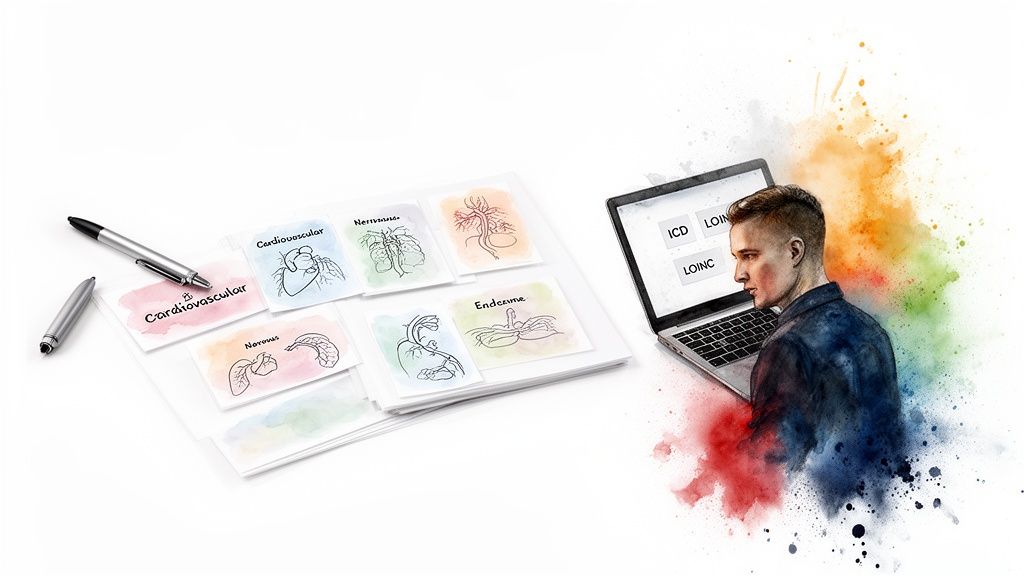
Once you’ve got the fundamentals of word construction down, any good syllabus will take you on a logical journey through the major body systems. This is what makes the information stick. You aren’t just learning words in a vacuum; you're connecting them to the anatomy and physiology of the human body, which is crucial for anyone working with healthcare data.
A typical progression through the body systems looks something like this:
- Integumentary System: Terms for skin, hair, and nails.
- Musculoskeletal System: Vocabulary for bones, muscles, joints, and related diseases.
- Cardiovascular System: Language related to the heart, blood vessels, and circulation.
- Respiratory System: The terms used to describe the lungs and airways.
- Nervous System: Terminology for the brain, spinal cord, and nerves.
This system-by-system structure helps you build a mental map of the human body. For example, in a cardiovascular module, you don’t just learn that cardi/o means "heart." You learn about myocarditis (inflammation of the heart muscle) within the context of how the heart functions. That’s far more useful when you’re trying to interpret real-world clinical data.
Connecting Terminology to Standardized Codes
Here’s where a contemporary course really diverges from the past: it has to connect the dots between clinical terms and the standardized vocabularies that run the healthcare industry. Simple definitions aren't enough anymore. As a data professional, you need to know how clinical concepts get codified for billing, research, and analytics.
The real skill isn't just defining terms; it's mapping them. A well-designed course teaches you how to connect a clinical concept like "myocardial infarction" to its ICD-10 code (I21) or a lab test like "serum potassium level" to its LOINC code (2823-3). This is ground zero for any ETL developer or clinical data analyst.
So, a module on the endocrine system wouldn’t just define diabetes mellitus. It would show you how that diagnosis is captured by ICD-10-CM codes (E10-E14) and how related lab tests and medications are coded using LOINC and RxNorm. This integrated approach prepares you for the realities of data mapping and standardization. You'll quickly find that knowing your way around these codes is essential, especially for tasks like performing an NDC code lookup to identify specific drugs in a dataset.
Learning Outcomes for Data Professionals
At the end of the day, a syllabus is designed to give you specific, tangible skills. The goal isn’t to turn you into a clinician; it’s to make you fluent in the language of clinical data.
After completing a solid course, you should be able to:
- Confidently Decipher Clinical Notes: Actually read and understand the terms used in patient charts, discharge summaries, and operative reports.
- Interpret Diagnostic and Procedural Codes: Know your way around the structure and logic of coding systems like ICD and CPT.
- Grasp the Context Behind the Data: See the clinical story that produced the data points you're analyzing.
- Communicate Effectively: Have more intelligent, productive conversations with clinicians and subject matter experts because you speak their language.
This is what a comprehensive approach looks like. You walk away with more than a vocabulary list; you gain a deep, structural understanding of medical language and how it powers the modern healthcare data ecosystem.
Choosing the Right Course Format for Your Career
Picking the right medical terminology course isn’t about finding a single "best" option. It's about finding the best fit for you. Your career path, how you learn best, and what your daily life looks like are the biggest factors in deciding where to invest your time and money.
The choice usually boils down to a trade-off between flexibility, cost, and how much direct interaction you want with an instructor. Let's break down the three main formats: self-paced online courses, live virtual classes, and traditional university programs. Looking at these through the lens of your professional goals is the first step to making a smart choice that actually moves your career forward.
Comparing Self-Paced, Instructor-Led, and University Courses
If you're already working a full-time job, flexibility is probably your top priority. This is where self-paced online courses shine, letting you squeeze in study sessions whenever you can. The catch? You have to be your own drill sergeant to stay on track.
Instructor-led virtual classes offer a nice middle ground. You get the structure of a real class with scheduled meeting times, but you can still attend from anywhere. When you're looking at these, it’s a good idea to dig into their teaching style by understanding synchronous and asynchronous communication. Live (synchronous) sessions are fantastic for asking questions on the spot, while self-paced (asynchronous) components give you breathing room.
Then there are traditional university programs. They often have the most comprehensive curriculum and carry serious academic credibility, but they're also the most expensive and rigid option.
The global shift to online learning has blown the doors wide open on available options. This isn't just a trend; it shows a real demand for specialized medical language skills, especially as flexible learning proves its worth for working professionals.
The Real-World Value of Certifications
So, does a certificate actually matter? For technical roles in health IT, the answer is a resounding yes.
A recognized credential is a clear signal to hiring managers. It validates that you have a structured, foundational grasp of clinical language and proves you're serious about the field. It’s tangible proof that you can handle complex documentation and work with standardized vocabularies.
When you're comparing courses, look for programs accredited or backed by reputable institutions. A certificate from a well-known organization carries a lot more weight on a resume, especially if you're aiming for roles in clinical research, data engineering, or health informatics where there’s zero room for error.
The demand for these courses has exploded alongside global higher education enrollment. Take UC San Diego's Medical English program, priced at $2,490 for its part-time track. It’s specifically designed for international healthcare professionals needing to get up to speed on the U.S. healthcare system. With a record 264 million students in higher education worldwide-up 25 million since 2020-the appetite for this kind of focused, online training has never been greater. Making a strategic investment in the right credentialed course is one of the smartest career moves you can make.
Focusing Your Learning for Technical Roles
A one-size-fits-all medical terminology course will only get you so far. If you're a technical professional working in healthcare, the real value comes from zeroing in on the specific challenges of your role. A general understanding is a decent starting point, but a specialized approach is what makes your skills truly indispensable.
The key is to shift your mindset from simply memorizing terms to understanding how they function as data. For a data engineer, the word myocarditis isn't just a clinical state; it's a concept that needs to be mapped, standardized, and correctly placed within an ETL pipeline. That context changes everything.
To help you find the right focus, let's look at how different technical professionals should approach learning medical terminology.
Medical Terminology Focus by Professional Role
The table below breaks down the primary focus areas, key applications, and most relevant vocabularies for three common technical roles in the healthcare data space.
| Role | Primary Focus Area | Key Application | Relevant Vocabularies |
|---|---|---|---|
| Data Engineer | Vocabulary Structure & Standardization: How codes are organized and related. | Building robust ETL pipelines; Mapping source data to a standard model like OMOP. | SNOMED CT, LOINC, RxNorm, ICD-10-CM/PCS |
| Clinical Researcher | Cohort & Outcome Definition: Precise terms for diseases, procedures, and patient attributes. | Constructing accurate patient cohorts for studies; Identifying specific clinical outcomes. | SNOMED CT, ICD-10-CM, CPT, HCPCS |
| NLP/ML Engineer | Language Nuance & Context: Synonyms, abbreviations, and misspellings in unstructured text. | Feature engineering for clinical language models; Extracting structured data from free-text notes. | All of the above, plus informal clinical shorthand |
As you can see, while everyone needs a foundational knowledge, the day-to-day application dictates where you should spend the most time and energy.
A Focus for Data Engineers
For data engineers, the entire world of healthcare data revolves around a central challenge: taming messy, inconsistent source data and wrestling it into a clean, standardized format. Your main goal in a medical terminology course should be mastering the vocabularies that make this possible, especially if you're working within an OMOP framework.
You’ll want to prioritize:
- Vocabulary Structure: Get into the weeds of how major terminologies like SNOMED CT, LOINC, and RxNorm are built. Understanding their hierarchies and relationships is the secret to building smart, accurate mapping logic.
- Concept Mapping: Focus on the terms and codes for diagnoses, procedures, and medications. You need to be able to confidently connect a source term like "Heart Attack" to its standard SNOMED CT concept ID for "Myocardial Infarction."
- ETL Logic: Frame everything you learn around building resilient ETL pipelines. Every term you study should be viewed through the lens of, "How would I map this from a source system to the OMOP Common Data Model?"
This approach makes your knowledge immediately useful for the core tasks of your job, turning clinical language into a tool for building better data systems.
A Focus for Clinical Researchers
Clinical researchers come at this from a different angle. Your job isn't just to move data, but to ask very specific questions of it. For you, medical terminology is the language you use to define patient populations, identify outcomes, and ensure your study's findings are both accurate and reproducible.
Your mastery of medical terminology directly impacts the validity of your research. An ambiguously defined cohort or a misinterpreted diagnostic code can invalidate months of work. Precision is everything.
A clinical researcher’s study plan should emphasize:
- Cohort Definition: Master the terminology around specific diseases, conditions, and patient characteristics. You need to know the exact codes for different types of cancer or stages of heart failure to build precise patient groups.
- Outcome Identification: Learn the vocabularies for procedures, lab results, and clinical events that will serve as your study's endpoints.
- Data Interpretation: Develop the fluency to read clinical notes and pathology reports to confirm that the coded data actually matches the clinical narrative.
A Focus for NLP and ML Engineers
For anyone working in NLP or machine learning, a deep, nuanced understanding of medical language is absolutely non-negotiable. You are literally teaching machines to read and interpret the most complex and context-dependent information in healthcare: unstructured clinical text.
Your focus has to be on the subtleties of the language itself. This means learning not just standard terms but also their common abbreviations, synonyms, and even frequent misspellings. Why? This granular knowledge is what you'll use for effective feature engineering and training accurate clinical language models.
You'll need to know that "MI" can mean myocardial infarction and that "CHF" means congestive heart failure, and how to tell the difference based on context. This foundational skill is a prerequisite for more advanced tasks. To see how these concepts connect in practice, check out our guide on semantic mapping. This deep dive into the practical language of medicine allows you to build models that can pull meaningful information from messy, real-world clinical notes.
Applying Your Knowledge in OMOP Workflows
This is where the rubber meets the road. A medical terminology course gives you the language, but applying it within an OMOP CDM pipeline is what transforms that knowledge into precise, reliable data mapping.
Think of it as moving from theory to practice. You’re no longer just learning terms; you’re actively using them to build the foundation for robust clinical analytics.
Mapping Source Terms with the OMOPHub SDK
For those working with code, tools like the OMOPHub API and SDKs are indispensable. They provide programmatic access to standardized vocabularies, letting you explore and map terms directly in Python or R.
Getting started is straightforward. Just install the Python package from our GitHub repository and set your API key.
from omophub import Client
client = Client(api_key="YOUR_API_KEY")
concepts = client.search_concepts("heart attack")
if concepts:
    cid = concepts[0]["concept_id"]
    print(cid)
R users can find similar functionality in the omophub-R package. For more in-depth examples, the official documentation at https://docs.omophub.com is your best resource.
When you're dealing with thousands or even millions of terms, efficiency is key. Batch processing is your friend here. Grouping 100 terms into a single request and running them in parallel threads can dramatically boost your throughput.
Tip:
- Chunk your source term lists into manageable batches, say 50–100 items.
- Use asynchronous calls to prevent your pipeline from stalling on high-volume lookups.
- Build in logic to automatically log and retry any entries that fail.
Integrating Terminology Directly Into Your ETL
The real power comes when you embed standardized codes like SNOMED CT and ICD-10 directly into your ETL (Extract, Transform, Load) pipeline. This simple step eliminates ambiguity at the source, ensuring the data is clean and ready for analysis from the moment it enters your system.
Precise vocabulary mapping is the foundation of reliable healthcare data workflows. It's not just a technical step; it's what ensures the data tells an accurate story.
The impact of having a firm grasp of this language is well-documented. A study involving 321 second-year medical students in a 15-session medical English course found a significant improvement (p < 0.001) in their understanding, regardless of whether the course was in-person, online, or a hybrid. You can read the full research about medical English course effectiveness to see the data for yourself.
To learn more about how these principles scale in a real-world analytics environment, check out our deep dive on the OMOP Common Data Model.
The diagram below illustrates how different technical roles interact with this process in a typical OMOP project. Each role has a unique but interconnected part to play.
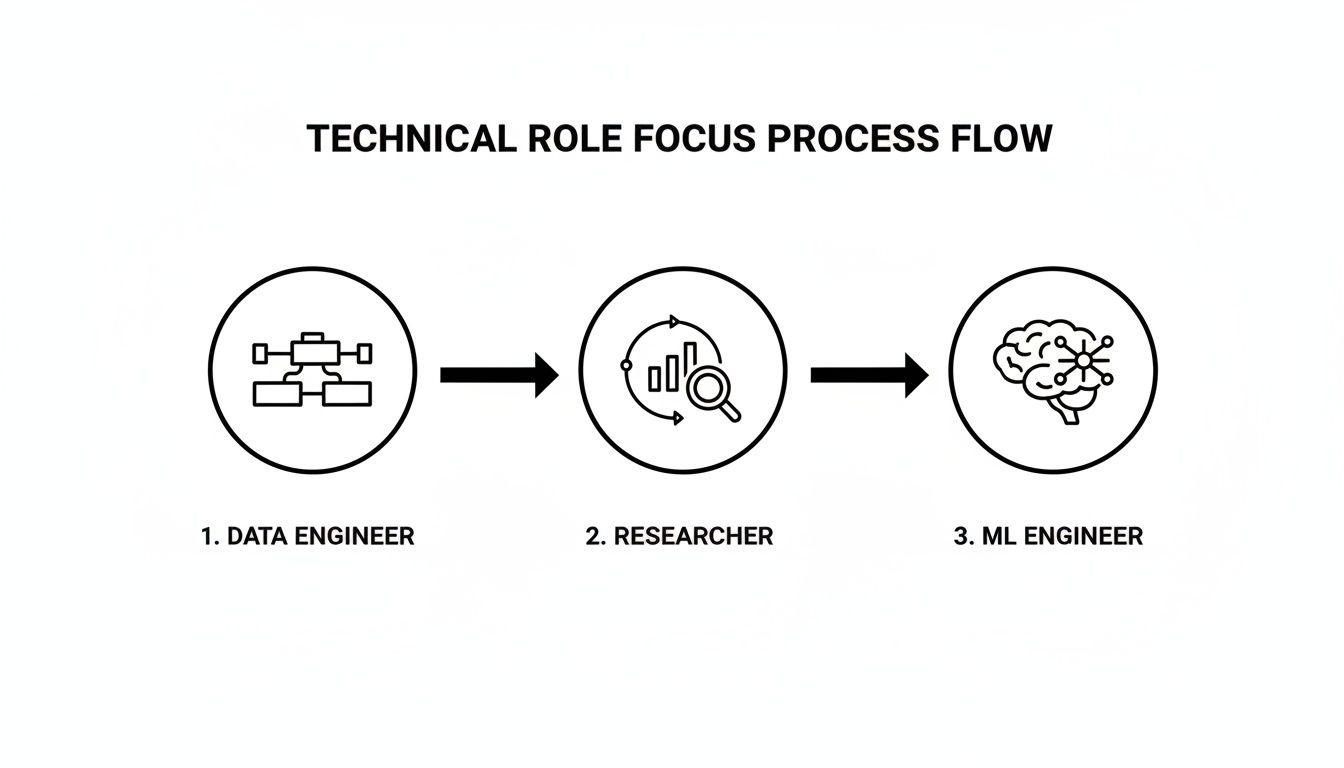
As you can see, data engineers are focused on automating the mappings, researchers use the standardized data to refine cohorts, and ML engineers leverage it to build sophisticated language models.
Maintaining Up-to-Date Vocabularies
Medical vocabularies are not static; they evolve. New codes are added, old ones are retired. Your system needs to keep pace. The best way to handle this is by automating your update process.
Tip:
- Set up a scheduled job (e.g., daily or weekly) to call the OMOPHub API and check for new ATHENA releases.
- Trigger an incremental ETL job to refresh your internal lookup tables with any changes.
- Run a suite of validation tests afterward to confirm that your mapping accuracy hasn't been compromised.
Handling Vocabulary Mismatches
Let's be realistic: not every source term will have a perfect one-to-one match in the standard vocabularies. You need a plan for these mismatches. Instead of letting them fail silently, implement fallback logic to flag unmapped terms and send them to a queue for manual review by a clinical expert.
This human-in-the-loop approach ensures no critical information gets lost.
Tip:
- Mark any unmapped terms with a specific status or flag in your database.
- Periodically export these lists into a spreadsheet for a clinician to validate.
- Once reviewed, update your custom mapping tables with the expert's input.
Frequently Asked Questions About Medical Terminology
If you're a technical professional stepping into healthcare data, you've probably got some questions about learning the language of medicine. It's a valid concern-you're a data engineer, researcher, or developer, not a clinician. Let's tackle the most common questions we hear so you can see why this training is so valuable and move forward with confidence.
How Long Does a Medical Terminology Course Typically Take?
The timeline really depends on the format. A self-paced online course might take you a few weeks, while a traditional university class will stretch over a 12 to 16 week semester.
But for a data professional, the goal isn't just a certificate of completion. True fluency comes from continuous, practical use. This is where tools that offer direct, programmatic access to live vocabularies, like the OMOPHub SDKs, can be more effective long-term than a one-and-done course.
Do I Need a Medical Background to Succeed in This Course?
Not at all. In fact, your background is a huge advantage. The same logical, systems-based thinking that makes you a great engineer is perfectly suited for learning medical terminology, which is incredibly structured.
Most good courses are built for beginners. They start with the fundamental building blocks-prefixes, roots, and suffixes-and teach you the rules for putting them together. Your analytical mind will feel right at home with this system.
Can I Learn This on the Job Instead of Taking a Course?
You'll definitely pick up some terms at work, but learning on the fly often creates a patchwork of knowledge. You'll know the terms for your specific project, but you'll lack the framework to understand anything outside of it.
A formal course gives you the system. It teaches you how to deconstruct any term you come across, not just the ones you've already memorized.
This foundational knowledge is what allows you to build scalable, accurate data pipelines without having to constantly ask for clinical validation. It's the key to working more autonomously and with greater confidence.
How Do I Keep My Terminology Knowledge Current?
Medicine never stands still. New discoveries, procedures, and coding standards mean the language is always evolving. To keep up, you need to follow updates from standards bodies like SNOMED International and, more importantly, use tools that handle vocabulary management for you.
This is where platforms like OMOPHub are a game-changer. They manage the complex versioning and updates for massive vocabularies like ATHENA, so you don't have to. Your data pipelines, analytics, and models are always running on the most current and accurate terminologies, completely automatically. You can see how this works on the OMOPHub Python SDK GitHub page.
Ready to eliminate the burden of managing healthcare vocabularies? OMOPHub provides instant API access to SNOMED, ICD-10, LOINC, and more, so your team can build faster and with confidence. Visit us at https://omophub.com to get started.