What is snomed: what is snomed and how it powers modern healthcare
 Alex Kumar, MS
Think of SNOMED CT as the universal translator for healthcare. It’s a massive, standardized clinical dictionary that lets a doctor in one country and a researcher in another describe the exact same diagnosis, symptom, or procedure in a way computer systems can understand without any confusion. This shared understanding is the bedrock for making sense of complex health data.
A Practical Guide to SNOMED CT
Imagine trying to assemble a piece of furniture with a team where everyone speaks a different language. One person calls a part a "screw," another a "fastener," and a third uses a specific brand name. It would be a mess. This is precisely the problem healthcare grapples with, and SNOMED CT is the elegant solution. It assigns a single, precise code to every clinical idea.
SNOMED CT, which stands for Systematized Nomenclature of Medicine Clinical Terms, is the world's most comprehensive clinical terminology. It’s huge-containing over 350,000 active concepts that cover everything from diseases and procedures to clinical findings and medications. As of 2023, it was implemented in more than 50 countries, with adoption picking up speed thanks to national mandates. You can find more detail on its global reach and structure on Tiro.health.
This level of standardization is what makes interoperability-the seamless sharing of data between different health systems-possible. Without a common language like SNOMED CT, an Electronic Health Record (EHR) from one vendor can't reliably communicate with another. It’s that simple.
To get a quick sense of what we're dealing with, here's a high-level summary.
SNOMED CT at a Glance
This table breaks down the core components of SNOMED CT into easily digestible pieces.
| Aspect | Description |
|---|---|
| What It Is | A comprehensive, multilingual clinical terminology. |
| Purpose | To standardize clinical documentation for unambiguous data exchange and analysis. |
| Size | Over 350,000 unique concepts, millions of descriptions, and millions of relationships. |
| Structure | A poly-hierarchical ontology, not a flat list. Concepts are linked by relationships. |
| Scope | Covers diseases, findings, procedures, body structures, organisms, substances, and more. |
| Governance | Managed globally by SNOMED International, with national extensions. |
In short, it’s not just a code system; it's a dynamic, interconnected knowledge base for all of medicine.
Why It Matters for Data and Analytics
The real magic of SNOMED CT is in its structure. It’s not just a flat list of terms; it’s an intricate web of interconnected concepts. This design allows a data system to understand that a "heart attack" is a more specific type of "myocardial ischemia," which in turn is a type of "heart disease." This built-in logic unlocks powerful analytics that would otherwise be impossible.
For data teams, this is a game-changer. Instead of hunting for dozens of different synonyms for a condition, you can query a single high-level SNOMED CT concept and automatically pull in all the specific sub-types nested beneath it.
Key Takeaway: SNOMED CT transforms messy, ambiguous free-text notes into structured, machine-readable data. This shift is the foundation for reliable data exchange, large-scale research, and the future of clinical AI.
Getting your hands on SNOMED CT usually means accessing official releases managed by SNOMED International. Their distribution page outlines the different ways to get access, whether through national release centers or affiliate licenses.
This controlled distribution is critical. It ensures everyone is working from the same standardized, up-to-date version, which is essential for maintaining data integrity across different systems and countries.
Unpacking the SNOMED CT Ontology
To really get what SNOMED CT is, you have to look under the hood. It’s not just a giant dictionary of medical terms; it’s a sophisticated, logical ontology built on three key pillars. Understanding these building blocks is essential to appreciating just how powerful it is for analyzing clinical data.
The whole system is designed to organize medical knowledge so that both people and computers can understand it without ambiguity. This robust structure is what makes meaningful queries and reliable data aggregation possible in the first place.
This diagram shows how SNOMED CT acts as the central engine, taking messy, raw healthcare data and structuring it for use around the globe.
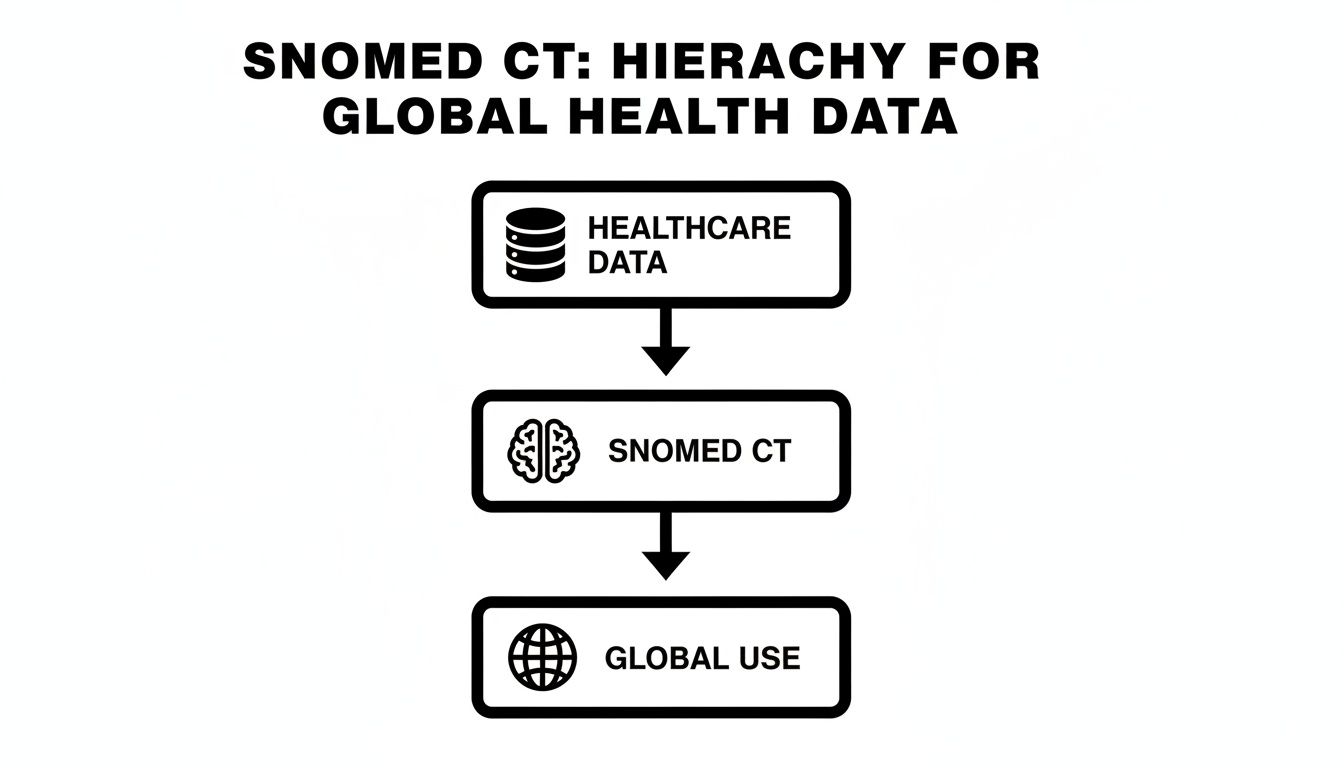
As you can see, SNOMED CT isn't just another data standard. It's the critical translator that turns complex clinical narratives into a standardized format ready for deep analysis and global application.
The Three Pillars: Concepts, Descriptions, and Relationships
Let's break down its architecture with a simple analogy. Think of SNOMED CT as the official language of medicine.
-
Concepts: These are the "nouns" of the language. Every concept represents a single, unique clinical idea-a diagnosis, a symptom, a procedure. For example, the idea of a heart attack is represented by the unique code
22298006. This numeric ID is its permanent, non-negotiable identifier. -
Descriptions: These are the "synonyms." A single concept can be described in multiple ways. The concept
22298006is linked to several descriptions, including the formal clinical term "Myocardial infarction" and the more common phrase "Heart attack." This brilliant feature ensures that no matter what term a doctor uses, the underlying meaning is captured correctly. -
Relationships: These are the "verbs" that connect the nouns and give the ontology its logical backbone. Relationships define how concepts are linked. For instance, one relationship tells us that
Myocardial infarction(is a)Ischemic heart disease. Another might define thatMyocardial infarction(has finding site)Myocardium.
This rich, interconnected web is what truly sets SNOMED CT apart. It creates a hierarchy where broad ideas branch into hyper-specific ones, allowing computer systems to understand the vital context behind the clinical data. Exploring this structure is key, and tools like a dedicated SNOMED CT browser can make navigating these connections much more intuitive.
Taming the Beast with Reference Sets
With over 350,000 active concepts, the full scope of SNOMED CT can be overwhelming and often too much for a single project. This is where Reference Sets (or Refsets) come into play. A Refset is simply a curated list-a subset of SNOMED CT components tailored for a specific need.
Think of a Reference Set as a custom playlist for medical terms. It filters the massive SNOMED CT library down to only what's relevant for a particular task, like creating a list of reportable diseases for a national health agency or defining the set of valid diagnoses for a clinical trial.
For instance, a hospital's cardiology department might create a Refset containing only concepts related to cardiovascular diseases. This not only simplifies data entry for clinicians but also ensures everyone in the department is speaking the same clinical language.
Practical Tips for Working with the SNOMED CT Ontology
Working with this kind of structure requires a mental shift-you have to move away from thinking in flat lists and start thinking in terms of a networked graph of knowledge. Here are a few practical tips to keep in mind:
-
Always Use the Concept ID: When storing data, always, always use the unique SNOMED CT concept ID, not the text description. Descriptions can be updated or retired, but the ID is forever.
-
Embrace the Hierarchy: The "is a" relationship is your best friend for running powerful queries. For example, if you query for
Ischemic heart disease, your query will automatically include records coded with its more specific children, likeMyocardial infarction, without you having to list out every single term. -
Watch for National Extensions: Be aware that many countries, including the U.S., publish their own extensions to SNOMED CT. These extensions add concepts relevant to their local healthcare systems, such as administrative codes, specific drug products, or public health requirements.
Why SNOMED CT Is So Critical for Modern Healthcare
It's one thing to understand SNOMED CT's complex architecture, but its real power comes alive when you see how it impacts patient outcomes, operational workflows, and advanced research. By creating a single, unambiguous language for clinical information, it helps healthcare move from a world of messy, fragmented notes to one of structured, computable data. This isn't just an academic exercise-it has profound, real-world consequences.
For clinicians on the front lines, this is all about patient safety. When a patient’s allergies, diagnoses, and procedures are recorded with precise SNOMED CT codes, the risk of clinical errors plummets. An EHR system can instantly flag a potentially dangerous drug interaction or alert a physician to a pre-existing condition, but only if the underlying data is clean and structured.
Driving Both Clinical and Business Value
The benefits don't stop at the examination room; they ripple through the entire healthcare ecosystem. The financial and operational advantages of adopting a standardized terminology are massive.
A solid business case shows clear reductions in duplicate or inappropriate clinical tests, fewer adverse drug events, and lower internal costs for developing and mapping terminologies. When patient records are structured with SNOMED CT, health systems can analyze population health trends, spot disease outbreaks sooner, and audit care delivery to find and correct outliers. This directly supports evidence-based protocols that cut the waste from redundant treatments and adverse events. You can dig deeper into the value of SNOMED CT on their official site.
Key Insight: Standardizing with SNOMED CT is an investment in data quality that pays dividends in patient safety, operational savings, and research capabilities. It turns clinical records from passive archives into active assets for decision-making.
This level of precision is also essential for next-generation healthcare technologies. For instance, building reliable chatbots for healthcare is nearly impossible without a standardized data backbone; they need accurate, structured information to provide safe and effective patient interactions.
A Breakthrough for Research and Analytics
For data scientists, biostatisticians, and clinical researchers, SNOMED CT is a complete game-changer. Historically, one of the biggest hurdles in large-scale research was the monumental effort needed to clean and harmonize data from different sources. Every hospital, clinic, or country might use slightly different terms for the same condition, which turned data aggregation into a painful, manual slog.
SNOMED CT acts as a universal key to unlock all these disparate datasets. Its hierarchical structure lets researchers run powerful queries that were once unthinkable. Instead of hunting for every possible synonym of "diabetes," a researcher can simply query the high-level "Diabetes mellitus" concept and instantly pull all related sub-types-from Type 1 to gestational diabetes-across millions of patient records. This transforms weeks of manual data cleaning into a few minutes of precise, repeatable work.
This is a massive win for teams building data pipelines.
- ETL Developers: Can build more reliable and automated workflows to map source data into a common data model like OMOP.
- Biostatisticians: Gain confidence that their study cohorts are defined correctly, leading to more credible and reproducible findings.
- AI Teams: Can train machine learning models on cleaner, more consistent data, which directly improves the accuracy of predictive algorithms for things like disease progression modeling.
Tips for Using SNOMED CT in Your Work
To get the most out of this powerful terminology, you need to approach it with the right strategy.
- Think Semantically, Not Just Text: When building tools or queries, don't just match text strings. Use the SNOMED CT hierarchy to find concepts and all their descendants. You can explore this in depth with the OMOPHub Search Concepts documentation.
- Master Versioning: SNOMED CT is updated regularly. Your systems must be able to handle different versions to maintain data integrity over time, especially when you're combining historical and current data.
- Use SDKs to Work Smarter: Instead of building your own tools to parse and query the terminology, use dedicated SDKs. Libraries like the OMOPHub Python SDK or R SDK give you pre-built functions for common tasks, saving you a ton of time.
How SNOMED CT Works With Other Terminologies
SNOMED CT doesn't exist in a bubble. It's a key player on a team of specialized terminologies, and if you work with healthcare data, you need to understand its specific role alongside standards like ICD, LOINC, and RxNorm. Each system has a distinct job, and they’re all designed to work in concert to create a complete and accurate picture of patient care.
Think of it like building a house. You wouldn't use a hammer for every single task. You need a saw for cutting wood, a wrench for plumbing, and a trowel for masonry. In the world of healthcare data, SNOMED CT is the master tool for detailed clinical documentation-it captures the nuanced "what" of a patient's condition. The other terminologies handle different, but equally important, jobs.
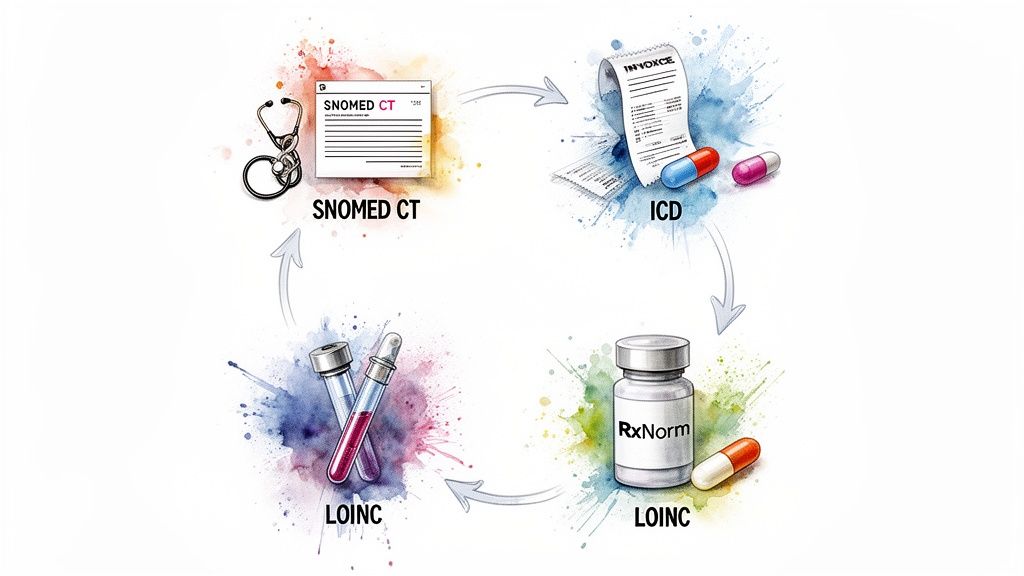
This interconnected ecosystem is what enables data to flow from the clinic to the billing department to the research lab. Each stop along the way gets the precise information it needs, in a language it understands.
SNOMED CT vs Other Key Terminologies
To really get a handle on this, it's helpful to see how these terminologies stack up against one another. The table below breaks down their primary purpose and the kind of data they're built to represent. It's this division of labor that makes the whole system work.
| Terminology | Primary Use Case | Scope |
|---|---|---|
| SNOMED CT | Detailed Clinical Documentation | Broad: Findings, procedures, diseases, substances, body structures |
| ICD | Billing & Reimbursement | Primarily diagnoses and procedures for statistical and billing purposes |
| LOINC | Lab Tests & Measurements | Observations, laboratory tests, clinical measurements, reports |
| RxNorm | Medications | Clinical drugs and drug delivery devices in the U.S. |
As you can see, SNOMED CT is all about capturing the granular clinical reality. ICD, on the other hand, is built for aggregation and reimbursement. LOINC and RxNorm dive deep into their specific domains-lab results and medications, respectively-providing a level of detail that SNOMED CT doesn't aim for in those areas.
The Critical Role of Mapping
For data teams, the real work begins when you have to connect these different languages. A single patient's record will inevitably contain codes from all of these systems. If you want to build a comprehensive patient timeline or conduct meaningful research, you absolutely must be able to translate between them.
This process is known as semantic mapping.
For instance, a clinician might document a diagnosis using a very specific SNOMED CT code for "Acute ST segment elevation myocardial infarction of anterior wall." For the claim to be paid, this needs to be mapped to the corresponding ICD-10-CM code. You can learn more about the challenges and solutions in our guide to semantic mapping in healthcare.
Mapping isn't a one-and-done task. It’s a continuous, foundational process for any data pipeline, especially when you're trying to get data into a standardized structure like the OMOP Common Data Model.
This is where automation becomes invaluable. Modern tools that can handle these complex translations programmatically save data engineers countless hours and dramatically cut down on the risk of manual errors.
Practical Tips for Terminology Integration
Integrating these systems successfully requires a clear strategy. Here are a few things to keep in mind:
- Understand Your Source: Always know which terminology is being used in your source data. Never assume a code is SNOMED CT just because it's sitting in a diagnosis field.
- Use Standardized Maps: Whenever you can, rely on official or well-vetted crosswalks between terminologies, like those provided through OHDSI's ATHENA. Avoid the temptation to create your own from scratch.
- Leverage APIs for Real-Time Mapping: For dynamic applications, using a REST API to perform mappings on the fly is far more efficient than trying to maintain massive, static mapping tables.
Getting Practical with OMOP and OMOPHub
Knowing what SNOMED CT is and actually using it are two very different things. This is where most data teams get stuck. The traditional path involves a ton of overhead: wrestling with complex licensing, keeping up with constant version updates, and maintaining a beefy local database just to house the terminology. Frankly, it's a slow, expensive distraction from the real work of finding insights in clinical data.
There’s a much cleaner way to do this. Instead of building and maintaining all that infrastructure yourself, you can plug directly into a versioned, compliant, and fast REST API. This approach outsources all the backend complexity, freeing up your team to focus on what they do best: building data pipelines and analytical tools.
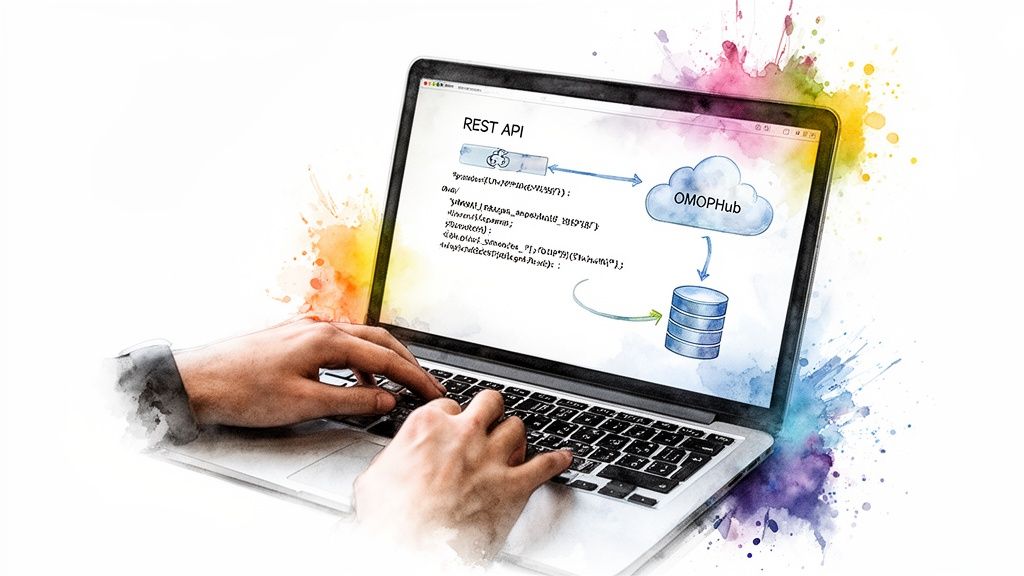
An API-first strategy completely changes the game. Tasks that used to take a database administrator weeks of setup can now be done in minutes with an API key and a few lines of code.
A Better Workflow with SDKs
To make life even easier, dedicated Software Development Kits (SDKs) for Python and R offer pre-built functions for the most common vocabulary tasks. This means you don't have to write a bunch of boilerplate code just to handle HTTP requests and parse API responses.
Let's say you need to search for a SNOMED CT concept. Instead of writing a manual SQL query against a local database, you just call a simple SDK function.
Python Example: Searching for a SNOMED CT Concept
Here’s a real, working code snippet using the OMOPHub Python SDK to find concepts related to "myocardial infarction."
from omophub.client import Client

# Initialize the client with your API key
client = Client(api_key="YOUR_API_KEY")

# Search for SNOMED CT concepts
# The vocabulary_id=["SNOMED"] filter ensures we only search within SNOMED CT
response = client.vocabulary.search_concepts(
    query="myocardial infarction",
    vocabulary_id=["SNOMED"]
)

# Print the name and ID of the first concept found
if response.concepts:
    concept = response.concepts[0]
    print(f"Concept Name: {concept.concept_name}")
    print(f"Concept ID: {concept.concept_id}")
That’s it. This script instantly pulls the relevant SNOMED CT concepts without any database setup on your end. You can find more examples like this in the official OMOPHub Python SDK on GitHub.
Exploring the Hierarchy with Code
Another incredibly useful feature is the ability to walk up and down the SNOMED CT hierarchy to find parent or child concepts. This is essential for tasks like cohort building, where you might need to find all patients with any condition that is a type of a specific disease.
R Example: Finding Concept Ancestors
This snippet for the OMOPHub R SDK shows how to find all the "Is a" ancestors of "Acute myocardial infarction."
# Install and load the OMOPHub R SDK
# install.packages("omophub")
library(omophub)

# Set your API key
set_api_key("YOUR_API_KEY")

# Find the ancestors of a specific SNOMED CT concept ID
# The concept ID for "Acute myocardial infarction" is 410429000
ancestors <- get_concept_ancestors(concept_id = 410429000)

# Print the results
print(ancestors)
Being able to navigate these relationships programmatically is a cornerstone of any serious clinical analytics work. For more R use cases, take a look at the OMOPHub R SDK on GitHub.
SNOMED CT is now a foundational piece for health data interoperability, thanks to years of international collaboration. Projects like the European ASSESS CT have confirmed it as the best-in-class core reference terminology. It's actively used in clinical systems across more than 50 countries for everything from patient problem lists to surgical procedures. You can learn more about its widespread adoption and value.
Tips for a Smooth Implementation
As you start pulling SNOMED CT into your daily work, especially within the OMOP Common Data Model, a few key practices can save you a world of headaches.
- Garbage In, Garbage Out: Before any data gets mapped, it has to be clean. Following solid data cleaning best practices is non-negotiable for ensuring the integrity of your final dataset.
- Stick to Standard Mappings: The OMOP CDM comes with standard, validated mappings from source codes (like ICD-10) to standard concepts (which are often in SNOMED CT). Use them. This is how you ensure your data is consistent and comparable. Our deep dive on the OMOP data model offers more on this.
- Let Someone Else Handle Versioning: SNOMED CT gets updated all the time. An API service like OMOPHub manages these updates for you, so your queries are always running against the correct, current version without you lifting a finger. You can see how this works in the OMOPHub versioning documentation.
- Automate Your ETL: Use the SDKs to build the vocabulary mapping steps directly into your ETL pipelines. This makes your entire data transformation process more reliable, repeatable, and much less vulnerable to human error.
The Future of Clinical Data Is Built on SNOMED CT
SNOMED CT isn't just another clinical standard; it's the semantic backbone for the future of healthcare. Its real power comes from its ability to structure clinical information for the next wave of innovation, whether that's AI-driven diagnostic tools, precision medicine initiatives, or global public health surveillance. The rich, intricate web of relationships within SNOMED CT is exactly what advanced systems need to make logical, context-aware inferences.
This level of detail is non-negotiable. The future of medicine hinges on data that is not only interoperable but truly computable. Healthcare is generating data at an unprecedented rate, and trying to manage these sprawling, ever-changing vocabularies manually has become a losing battle. For any data team, maintaining local databases and keeping pace with constant updates is an enormous resource drain.
Why an API-First Strategy Is No Longer Optional
This is precisely why API-driven solutions are becoming the go-to for modern healthcare organizations. When you connect to a service like OMOPHub, your team can sidestep the massive overhead of infrastructure management and get straight to the work that matters-innovation. This move from manual updates to programmatic access isn't just about convenience; it's a strategic imperative.
The message here is simple: stop seeing standardized terminologies as a hurdle. Think of SNOMED CT as a powerful asset waiting to be used, and an API is the key that unlocks it.
This model gives you scalable, secure, and always-current access to the terminologies that fuel modern analytics, without the headaches of doing it all yourself.
Practical Steps to Future-Proof Your Data Strategy
To get ahead of the curve, data teams should be thinking about workflows that are both agile and built to scale.
-
Automate Your Vocabulary Workflows: Stop doing manual lookups. Build your ETL and analytics pipelines with SDKs that handle vocabulary queries programmatically. You can find excellent, ready-to-use tools on GitHub for both Python and R.
-
Cut the Cord from Local Databases: Get out of the business of managing terminology tables on local infrastructure. Moving away from this model simplifies maintenance and guarantees you're always using the latest official releases without lifting a finger.
-
Anticipate and Adapt to Change: SNOMED CT is a living standard. For instance, SNOMED International plans to increase the character limit for descriptions in July 2026 to better capture complex clinical ideas. A good API partner will absorb these kinds of changes for you, so your systems never miss a beat.
By embracing standardized terminologies through a modern, API-first approach, you can finally unlock the real potential of your clinical data and help drive meaningful breakthroughs in patient care and research for years to come.
SNOMED CT: Your Questions Answered
Okay, let's get into the practical side of things. After diving into the theory, most people-developers, data scientists, and researchers alike-run into a few common questions when they start to actually use SNOMED CT. Here are the straight answers to the ones we hear most often.
Is SNOMED CT Free?
It’s a classic "it depends" situation. If you're in a SNOMED International member country, like the U.S. or the U.K., then yes, it's generally free to use. But for non-member countries or some specific commercial products, you'll likely need to get an affiliate license.
My advice? Don't make assumptions. Before you build SNOMED CT into any part of your production workflow, double-check your country's status and your exact use case on the official SNOMED International website. It's a critical compliance step that can save you a lot of headaches later on.
How Often Is SNOMED CT Updated?
Twice a year. The core International Edition is refreshed every January and July. On top of that, individual countries often release their own extensions. The U.S. Edition, for instance, is also released twice a year, usually in March and September, adding concepts specific to the American healthcare system.
Keeping up with this constant stream of updates is a massive operational lift for any team managing their own vocabulary servers. This is exactly why a managed API that handles all the versioning for you is so valuable. We cover how we manage this in the OMOPHub versioning documentation.
What Are the Biggest Hurdles in a Real-World Implementation?
Beyond the licensing and update treadmill, a few major challenges consistently trip people up:
- The Mapping Nightmare: Taking messy, local, non-standard codes and accurately mapping them to the right SNOMED CT concepts is a beast. It’s a slow, painstaking process that demands serious clinical and technical know-how.
- Wrestling with the Hierarchy: Let’s face it, most databases aren’t built to handle a graph. Trying to run sophisticated hierarchical queries-the very thing that makes SNOMED CT so powerful-often feels like fitting a square peg in a round hole with traditional systems.
- The Post-Coordination Puzzle: This is an incredibly powerful feature where you can combine concepts to express a highly specific clinical idea, like "fracture of left femur due to fall." But actually implementing the logic to build and interpret these "post-coordinated expressions" correctly is a significant engineering challenge.
Any Big Changes Coming Up That I Should Prepare For?
Yes, there's a big one on the horizon. SNOMED International is planning to increase the maximum length for concept descriptions from 255 to 4096 characters. This change is set to roll out with the July 2026 International Edition.
Why the change? It's mostly to handle the increasingly complex names of things like pharmaceutical products-think multivalent vaccines with a long list of ingredients. If your database schema has a hardcoded 255-character limit for these fields, you'll need a plan to update it, or you'll run into data truncation errors. It’s another great example of where an API service shines, as it insulates you from having to worry about the underlying schema.
Tired of wrestling with SNOMED CT updates, mapping, and database management? OMOPHub gives your team instant REST API access, letting you skip the vocabulary headaches and get straight to building. Check out the platform and grab your API key at https://omophub.com.