8 Essential Tools and Frameworks to Master Your HEOR Workflow in 2026
 Dr. Rachel Green
Health Economics and Outcomes Research (HEOR) is the critical discipline that bridges clinical evidence with real-world value, guiding decisions from regulatory approvals to patient access. However, the path from raw healthcare data, spanning electronic health records (EHRs), claims, and registries, to credible evidence is fraught with challenges. Issues like data fragmentation, inconsistent coding, and methodological complexity can derail even the most well-designed studies. A successful HEOR strategy requires a sophisticated toolkit of standardized data models, clinical terminologies, and robust analytical frameworks.
To effectively transition from data chaos to actionable insights, a strong foundation in healthcare data engineering is paramount. This specialized expertise ensures that disparate data sources are properly ingested, standardized, and prepared for rigorous analysis, forming the bedrock upon which reliable evidence is built. Without it, researchers face significant hurdles in generating the high-quality data assets required for modern HEOR investigations.
This roundup details the 8 essential components that form the backbone of a modern HEOR program, providing a practical roadmap for generating reproducible, high-impact real-world evidence (RWE). We will move beyond high-level definitions to explore not just what these tools are, but how to implement them effectively. You will find specific, actionable tips, practical examples, and clear guidance on using OMOP-standardized vocabularies and OMOPHub APIs to accelerate your analytical workflows. Whether you are building an ETL pipeline, designing a comparative effectiveness study, or seeking to integrate standardized terminologies, this guide provides the technical details needed to turn complex health data into decisive evidence.
1. OHDSI (Observational Health Data Sciences and Informatics)
The Observational Health Data Sciences and Informatics (OHDSI) collaborative is a global, multi-stakeholder initiative dedicated to generating reliable evidence from large-scale health data. It provides the foundational ecosystem for standardizing disparate healthcare data sources, making it a cornerstone for modern Health Economics and Outcomes Research (HEOR). At its core, OHDSI offers the Observational Medical Outcomes Partnership (OMOP) Common Data Model (CDM), a standardized structure for observational health data.
This standardization is critical for HEOR because it allows researchers to execute a single analysis script across a federated network of databases, each mapped to the OMOP CDM. This dramatically accelerates the generation of real-world evidence (RWE) by overcoming the immense challenge of data heterogeneity. OHDSI provides a suite of open-source tools for every stage of the research pipeline, from data transformation (ETL) to population-level effect estimation.
Why OHDSI is Essential for HEOR
OHDSI’s primary value lies in its ability to produce transparent, reproducible, and scalable research. For HEOR studies, this means that findings related to treatment effectiveness, safety, and cost can be validated across diverse patient populations and healthcare systems globally. This federated approach ensures patient privacy is maintained, as only aggregated results are shared, not patient-level data.
- Example: The FDA's Sentinel System utilizes a distributed data network based on a common data model to monitor the safety of regulated medical products. Similarly, the European Health Data & Evidence Network (EHDEN) is actively standardizing health records from across Europe to the OMOP CDM, enabling large-scale, pan-European HEOR studies.
Practical Implementation Tips
Adopting the OMOP CDM requires a strategic approach. Start by building internal expertise and leveraging the extensive OHDSI community for support.
- Build Team Literacy: Begin with OHDSI's educational resources, including "The Book of OHDSI" and community webinars, to establish a strong foundational understanding.
- Leverage Community Support: The global OHDSI forums and Slack channels are invaluable resources for troubleshooting specific ETL challenges and learning best practices from experienced implementers.
- Streamline Vocabulary Management: The process of mapping local source codes (like ICD-10, CPT, or proprietary codes) to standard OMOP concepts is a major hurdle. Instead of building and maintaining complex local ATHENA infrastructure, you can use a managed service like OMOPHub. Its APIs accelerate concept mapping and vocabulary management. For more details, see the OMOPHub API documentation.
- Start Small and Validate: Implement a pilot project focusing on a specific cohort or disease area. This allows your team to validate ETL logic and data quality before committing to a full, enterprise-wide conversion.
2. SNOMED CT (Systematized Nomenclature of Medicine Clinical Terms)
The Systematized Nomenclature of Medicine Clinical Terms (SNOMED CT) is a comprehensive, multilingual clinical health terminology. It provides a standardized and scientifically validated way to represent clinical information, covering diseases, findings, procedures, substances, and more. Maintained by SNOMED International, it enables semantic interoperability, allowing clinical data to be accurately recorded, shared, and analyzed across different electronic health record (EHR) systems and geographic regions.
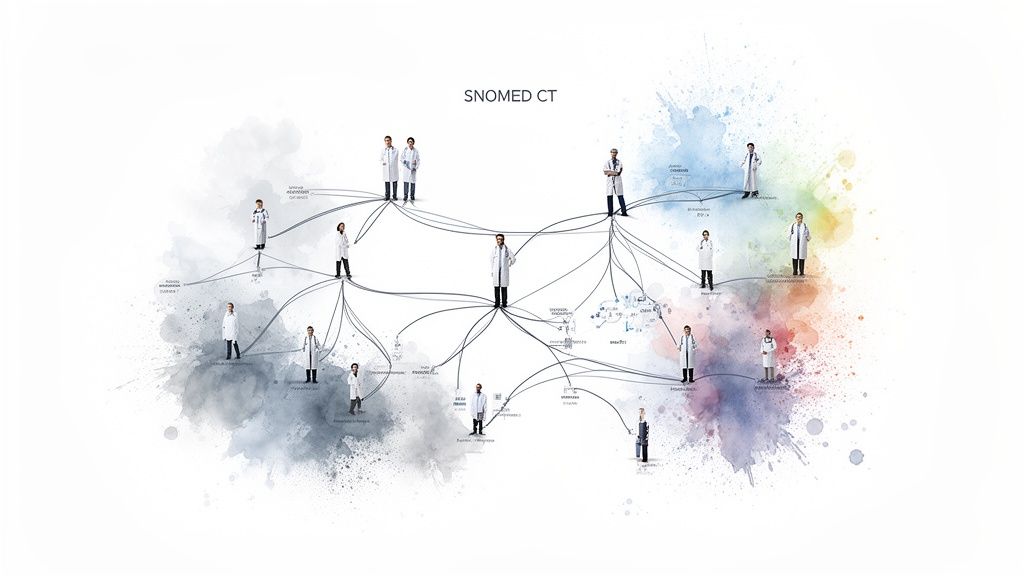
This semantic precision is foundational for high-quality Health Economics and Outcomes Research (HEOR). By providing a common language for clinical concepts, SNOMED CT eliminates the ambiguity inherent in proprietary or local coding systems. Its hierarchical structure, which connects concepts through defined relationships (e.g., "Viral pneumonia" Is a "Infectious pneumonia"), allows for powerful, clinically meaningful data aggregation and cohort definition. Within the OHDSI ecosystem, SNOMED CT is a core component of the standard vocabularies.
Why SNOMED CT is Essential for HEOR
SNOMED CT’s core value in HEOR lies in its clinical granularity and hierarchical logic, which enable precise and scalable real-world evidence generation. It allows researchers to define highly specific patient populations that would be impossible to identify using broader, administrative classification systems like ICD-10 alone. This precision ensures that cost-effectiveness and comparative effectiveness studies are based on clinically coherent and accurate cohorts, leading to more reliable findings.
- Example: The UK’s National Health Service (NHS) mandates SNOMED CT as the single clinical terminology for all primary and secondary care settings. This standardization supports national-level HEOR initiatives, public health surveillance, and ensures consistent data capture for research across the entire healthcare system.
Practical Implementation Tips
Effectively leveraging SNOMED CT requires robust tools for mapping and navigating its complex structure. Manual processes are often inefficient and prone to error.
- Leverage Hierarchies: Use the ontological relationships within SNOMED CT to build more robust cohort definitions. For example, instead of listing every type of heart failure, you can select the parent concept "Heart failure" (42343007) and programmatically include all its descendants, ensuring comprehensive cohort capture.
- Validate Mappings: Always involve clinical domain experts to validate mappings from source data to SNOMED CT concepts. This step is critical to prevent semantic drift, where a source code is mapped to a technically correct but clinically inappropriate SNOMED CT concept.
- Simplify Concept Lookups: Mapping source codes to standard SNOMED CT concepts is a frequent and resource-intensive task. Instead of managing complex local vocabulary infrastructure, you can use managed API endpoints like OMOPHub to programmatically search and map concepts, bypassing licensing complexities. See the OMOPHub concept mapping documentation for API details.
- Implement Caching: For high-volume ETL pipelines that perform repetitive concept lookups, implement a local caching strategy. Storing frequently accessed SNOMED CT concept mappings temporarily can significantly reduce API calls and improve data processing performance.
3. RxNorm (Medication Terminology Standard)
RxNorm, maintained by the U.S. National Library of Medicine (NLM), is a standardized nomenclature for clinical drugs that provides unambiguous names and identifiers for medications and their components. It encompasses brand names, generic names, ingredients, strength, and formulation, linking them together through a network of relationships. For any Health Economics and Outcomes Research (HEOR) analysis involving medications, RxNorm is the foundational standard for harmonizing drug exposure data.

This standardization is achieved by assigning a unique RxNorm Concept Unique Identifier (RxCUI) to each distinct drug concept. This allows HEOR researchers to aggregate and compare drug utilization and outcomes across disparate data sources, such as different electronic health record (EHR) systems or pharmacy claims databases, that use proprietary or local drug codes. Integrating RxNorm into the OMOP Common Data Model is a critical step for ensuring that medication exposures are accurately and consistently represented, enabling reliable pharmacoepidemiology and drug safety studies.
Why RxNorm is Essential for HEOR
RxNorm’s primary value in HEOR is its ability to normalize medication data, which is notoriously fragmented. It allows researchers to move beyond simple string matching of drug names and instead group medications by their clinically relevant attributes, such as active ingredients or therapeutic class. This hierarchical structure is indispensable for conducting robust comparative effectiveness research, pharmacovigilance studies, and analyses of medication adherence.
- Example: A real-world evidence study comparing the effectiveness of different statins requires grouping various branded and generic products (e.g., Lipitor, Zocor, generic atorvastatin) into a single "statin" cohort. RxNorm’s relationships allow researchers to programmatically identify all relevant medications by their shared active ingredients, ensuring a comprehensive and accurate cohort definition.
Practical Implementation Tips
Effectively leveraging RxNorm requires a robust strategy for mapping source drug codes to standard RxCUIs during the ETL process and maintaining these mappings over time.
- Map with Precision: When mapping raw pharmacy data to RxCUIs, aim for the most granular level of detail available in the source data. Map to the Semantic Branded Drug (SBD) or Semantic Clinical Drug (SCD) level to capture brand, ingredient, strength, and dose form information accurately.
- Build Semantic Groupers: Instead of creating and maintaining brittle, hard-coded lists of drug names for therapeutic classes (e.g., 'all beta-blockers'), use RxNorm's relationship tables. Traverse the hierarchy from an ingredient concept to find all associated clinical products, which makes the analysis more reproducible and scalable.
- Automate Vocabulary Mapping: Manually mapping thousands of local drug codes is inefficient and error-prone. Use a dedicated API like OMOPHub's RxNorm endpoints to automate the translation of raw drug descriptions or codes (like NDC) into standard RxCUIs during your ETL pipeline. See the OMOPHub API documentation for implementation details.
- Version Your Concepts: RxNorm is updated regularly to reflect new drug approvals and market changes. Document the specific RxCUIs and the vocabulary version used in your analysis to ensure reproducibility. Be aware that RxCUIs can change, so validate mappings after each vocabulary update.
4. LOINC (Logical Observation Identifiers Names and Codes)
Logical Observation Identifiers Names and Codes (LOINC) is the international standard for identifying laboratory and clinical test results, maintained by the Regenstrief Institute. It provides a comprehensive set of universal codes for tests, measurements, and observations, enabling semantic interoperability across disparate electronic health record (EHR) systems, lab networks, and research platforms. This makes LOINC a foundational vocabulary for standardizing a critical data domain in Health Economics and Outcomes Research (HEOR).

Standardizing measurement data is essential for generating reliable real-world evidence. Without LOINC, a simple concept like "hemoglobin A1c" might be represented by hundreds of different proprietary codes and descriptions across various labs, making large-scale analysis impossible. LOINC solves this by assigning a unique, unambiguous code to each observation, allowing researchers to accurately pool and compare data from diverse sources. This normalization is a prerequisite for any robust HEOR analysis involving clinical measurements, from comparative effectiveness studies to patient-reported outcomes.
Why LOINC is Essential for HEOR
LOINC’s value in HEOR lies in its ability to create analytically consistent and comparable datasets from messy, real-world clinical data. By harmonizing how laboratory tests and clinical observations are recorded, LOINC ensures that researchers are comparing the same clinical concepts across different patient populations and care settings. This precision is vital for building accurate economic models, evaluating treatment pathways, and assessing patient outcomes with confidence.
- Example: During the COVID-19 pandemic, public health agencies relied on LOINC codes to aggregate and normalize test results from thousands of different laboratories. This standardization enabled near real-time surveillance of infection rates, a critical component of the public health response that informed policy and resource allocation.
Practical Implementation Tips
Effectively mapping source laboratory codes to standard LOINC concepts is a common challenge in data standardization pipelines. A combination of programmatic tools and domain expertise is required.
- Programmatic Mapping: Instead of manual lookups, use programmatic tools to map local lab test codes to standard LOINC concepts during the ETL process. The OMOPHub API provides endpoints specifically for LOINC mapping, which can handle vendor-specific variations and streamline vocabulary integration. For technical details, see the OMOPHub vocabulary mapping documentation.
- Leverage Hierarchies: Use LOINC’s hierarchical structure to define broader phenotypes for cohort building. For example, a researcher can create a cohort of all patients with any type of glucose measurement, not just a specific HbA1c test, by leveraging the relationships defined within the vocabulary.
- Validate with Experts: Always validate LOINC mappings with clinical and laboratory domain experts. Their input is crucial for correctly mapping rare or custom assays where automated mapping tools may lack context, ensuring the integrity of your heor study data.
- Normalize Units: Implement logic to normalize measurement units using LOINC's detailed attributes like
PropertyandScale. This step prevents analytical errors that can arise from comparing results reported in different units (e.g., mg/dL vs. mmol/L).
5. ICD-10-CM/PCS (International Classification of Diseases, 10th Revision)
The International Classification of Diseases, 10th Revision, is the cornerstone vocabulary for diagnostic and procedural coding within the U.S. healthcare system. Maintained by the Centers for Disease Control and Prevention (CDC) and the Centers for Medicare & Medicaid Services (CMS), it comprises two parts: ICD-10-CM (Clinical Modification) for diagnoses and ICD-10-PCS (Procedure Coding System) for inpatient procedures. These detailed code sets are essential for billing, health services management, and epidemiological surveillance.
For HEOR, ICD-10 codes found in administrative claims data are a primary source for defining patient cohorts, identifying comorbidities, and specifying study outcomes. However, their primary purpose as a billing vocabulary introduces challenges for clinical research, as codes may lack the necessary granularity or be chosen to optimize reimbursement rather than reflect precise clinical truth. To overcome this, these source codes must be mapped to a standard clinical reference vocabulary like SNOMED CT within the OMOP Common Data Model, enabling consistent and reliable analysis.
Why ICD-10-CM/PCS is Essential for HEOR
The primary value of ICD-10 lies in its ubiquity in U.S. healthcare claims data, providing a massive, longitudinal data source for HEOR and pharmacoepidemiology. When properly standardized, this data allows researchers to conduct large-scale, real-world evidence studies on treatment patterns, drug safety, and disease burden. This process transforms administrative data into a powerful asset for generating evidence on a population scale.
- Example: A health economics study might use Medicare claims to evaluate the long-term cost-effectiveness of a new cardiovascular drug. Researchers would identify patient cohorts using ICD-10-CM codes for specific heart conditions and track outcomes like hospital readmissions, also defined by ICD-10 codes, to model the economic impact.
Practical Implementation Tips
Effectively leveraging ICD-10 data requires robust vocabulary mapping and a deep understanding of how coding practices can influence data quality.
- Standardize Vocabulary Mappings: The critical first step is mapping raw ICD-10 codes to standard SNOMED CT concepts. Instead of building complex internal mapping logic, use a managed service like OMOPHub. Its API endpoints for ICD-10-CM and ICD-10-PCS simplify and accelerate the translation of billing codes into research-grade clinical concepts. See the OMOPHub API documentation for details.
- Manage Annual Updates: ICD-10 code sets are updated annually on October 1. Implement a process to ingest these updates and validate that existing cohort definitions and concept sets are not negatively impacted. This ensures longitudinal study consistency.
- Enhance Clinical Specificity: Create outcome definitions using carefully curated concept sets. For example, differentiate between acute myocardial infarction with ST-segment elevation (STEMI) and non-ST-segment elevation (NSTEMI) by selecting the appropriate ICD-10 codes and their corresponding SNOMED CT concepts to ensure clinical precision.
- Validate with Domain Experts: Always validate ICD-10 to SNOMED CT mappings with clinical experts. A code used for billing might not fully capture the clinical nuance required for a specific HEOR study, and expert review is crucial to prevent misclassification bias.
6. OHDSI ATLAS (Analysis Tools with Large-Scale Information Standards)
ATLAS is OHDSI's open-source web application for designing and executing standardized clinical analyses on OMOP CDM databases. It serves as the primary user interface for the OHDSI tool stack, providing an intuitive, point-and-click environment that makes sophisticated HEOR analytics accessible to researchers, clinicians, and epidemiologists who may not have deep programming expertise. Its core function is to empower users to create complex cohort definitions, design population-level studies, and visualize results.
By offering a graphical interface for defining patient populations and analyses, ATLAS democratizes access to real-world data. It enables non-technical stakeholders to directly engage in the evidence generation process, translating clinical questions into executable logic. This significantly enhances collaboration between clinical experts and data scientists, ensuring that HEOR studies are both technically sound and clinically relevant. ATLAS integrates seamlessly with other OHDSI tools to run characterizations, incidence rate analyses, and population-level effect estimations.
Why ATLAS is Essential for HEOR
ATLAS's value in the HEOR landscape comes from its ability to standardize and accelerate the most critical and time-consuming phases of observational research: cohort definition and analysis design. It promotes transparency and reproducibility by allowing study specifications to be easily shared, reviewed, and executed across any OMOP-compliant database in a federated network. This makes multi-site studies, which are crucial for generating robust real-world evidence, far more efficient to implement.
- Example: A pharmaceutical company conducting a post-market safety surveillance study can use ATLAS to define the patient cohort exposed to a new drug. This exact definition can then be shared with research partners across the EHDEN network, each of whom can execute the analysis on their local data without sharing patient-level information, generating consistent and verifiable evidence.
Practical Implementation Tips
Effectively leveraging ATLAS requires a focus on both technical setup and collaborative best practices. Start by ensuring a proper installation connected to your OMOP CDM and then establish clear team workflows.
- Validate Cohorts Before Analysis: Use the built-in CohortDiagnostics tool within ATLAS to rigorously assess your cohort definition. This feature helps identify potential issues like low patient counts, unexpected demographic distributions, or misaligned concept sets before you invest time in a full-scale analysis.
- Ensure Reproducibility with CirceR: For publication-ready research and regulatory submissions, export your ATLAS-defined cohort and analysis specifications into a format that can be used by the CirceR R package. This creates a fully documented and machine-readable script, ensuring your methods are transparent and perfectly reproducible.
- Establish Naming Conventions: In a collaborative environment, create and enforce strict naming conventions for concept sets, cohorts, and analyses within ATLAS. A clear system (e.g.,
[Project]_[Disease]_[LineOfTherapy]_[Version]) prevents confusion and makes assets easier to find and reuse. - Implement Role-Based Access: Secure your ATLAS instance by implementing role-based access controls. This allows you to segregate permissions, creating separate environments for development, validation, and production analyses, which is critical for maintaining data governance and study integrity.
7. Journal of Medical Internet Research (JMIR) and Health Economics & Outcomes Research Journals
Peer-reviewed academic journals are the primary channels for disseminating and validating Health Economics and Outcomes Research (HEOR). Journals such as VALUE IN HEALTH, Pharmacoeconomics, Journal of Medical Economics, and the Journal of Medical Internet Research (JMIR) are critical for establishing the standards of evidence in the field. They provide the platforms where new methodologies, real-world evidence (RWE) studies, and economic evaluations are scrutinized, refined, and ultimately accepted by the scientific and regulatory communities.
These publications enforce methodological rigor and transparency, ensuring that HEOR findings are reproducible and trustworthy. For data-driven HEOR, they set the benchmark for everything from study design and cohort definition to statistical analysis and the interpretation of results. By publishing studies that leverage standardized data models like OMOP, these journals advance the entire field, demonstrating how to generate reliable evidence from complex, large-scale health data sources to inform healthcare policy and clinical practice.
Why Leading Journals are Essential for HEOR
The core value of these journals in HEOR lies in their rigorous peer-review process, which validates the scientific integrity of research. They ensure that published studies meet high standards for study design, statistical analysis, and ethical considerations. For practitioners, these journals are an indispensable resource for staying current with cutting-edge methods, understanding emerging trends, and benchmarking their own research against the accepted standards in the HEOR community.
- Example: A study published in VALUE IN HEALTH might validate a cost-effectiveness model using a large, multi-database RWE analysis conducted on an OMOP-standardized network. Similarly, Pharmacoepidemiology and Drug Safety frequently features pharmacovigilance studies that rely on claims data where drug exposures are accurately identified using standardized vocabularies like RxNorm.
Practical Implementation Tips
Aligning your research with the standards of top-tier journals from the outset is crucial for successful publication and impact. This proactive approach helps shape a robust study that meets reviewer expectations.
- Adhere to Reporting Guidelines: Before starting your analysis, consult established reporting guidelines. Use STROBE (Strengthening the Reporting of Observational Studies in Epidemiology) for observational studies and CHEERS (Consolidated Health Economic Evaluation Reporting Standards) for economic evaluations to structure your protocol and manuscript.
- Plan for Open Access: Many institutions and funding bodies, including the NIH, mandate open-access publication. Plan for this early in your project timeline and budget, as it significantly increases the visibility and impact of your HEOR findings.
- Leverage Published Methodologies: Review existing studies in your target journal that address similar research questions or use similar data sources. This helps anticipate potential methodological challenges, refine your study design, and address likely reviewer concerns before submission.
- Ensure Vocabulary Transparency: When using standardized models like OMOP, clearly document your vocabulary mapping and concept set definitions. For instance, if mapping local lab codes to LOINC, you can use managed services to ensure accuracy and reproducibility. The OMOPHub API documentation provides guidance on programmatic vocabulary management.
8. Real-World Evidence (RWE) Generation Frameworks and Study Designs
Real-World Evidence (RWE) generation frameworks provide the methodological backbone for analyzing real-world data (RWD) from sources like EHRs, claims, and registries to answer critical questions about treatment effectiveness and safety. These frameworks, such as target trial emulation, bring the rigor of randomized controlled trials (RCTs) to observational research, enabling scientifically sound conclusions that can inform regulatory and clinical decisions. This structured approach is essential for modern HEOR, as it ensures that studies are transparent, reproducible, and robust enough for high-stakes evaluations.
Standardization via models like the OMOP CDM is foundational for implementing these frameworks at scale. It allows researchers to define a single, precise protocol and execute it across a distributed network of databases, generating evidence that is both portable and comparable across diverse populations. This capability transforms HEOR by making it possible to conduct large-scale observational studies that rival the scope of traditional clinical trials but at a fraction of the time and cost.
Why RWE Frameworks are Essential for HEOR
The primary value of these frameworks lies in their ability to minimize bias and improve the causal interpretability of observational studies. For HEOR, this means that assessments of comparative effectiveness, cost-effectiveness, and safety are built on a stronger scientific foundation. By explicitly defining study parameters like eligibility criteria, treatment assignment, and outcomes, researchers can generate evidence that regulatory bodies like the FDA and EMA are increasingly willing to accept for decision-making.
- Example: OHDSI network studies on COVID-19 therapeutics used a standardized framework to rapidly generate RWE on treatment effectiveness across multiple countries. Similarly, the FDA has increasingly accepted RWE from disease registries and observational studies to support accelerated approvals and label expansions, demonstrating the growing trust in these methodologies when executed properly.
Practical Implementation Tips
Successfully implementing RWE frameworks requires a disciplined, protocol-driven approach and a deep understanding of potential biases.
- Adopt Target Trial Emulation: Before any analysis, explicitly define the protocol for a hypothetical pragmatic trial you aim to emulate. This includes specifying eligibility criteria, treatment strategies, assignment procedures, follow-up periods, and outcomes. This rigor is crucial for strengthening causal inference.
- Implement Robust Bias Controls: Use techniques like negative control outcomes and empirical calibration to quantify and adjust for residual systematic error. This helps distinguish true causal effects from biases inherent in the observational data.
- Promote Transparency: Prospectively register your study protocol on platforms like ClinicalTrials.gov or the Open Science Framework. This practice increases transparency, reduces publication bias, and builds confidence in your HEOR findings.
- Ensure Reproducible Cohorts: Leverage standardized vocabularies to create cohort definitions that are portable across different datasets. While mastering systematic literature review methodology is vital for evidence synthesis, using APIs from services like OMOPHub can streamline the creation of reproducible phenotypes by programmatically mapping source codes to standard concepts, ensuring your study can be replicated by others.
HEOR - 8-Item Comparison of Standards, Tools & Evidence
| Item | 🔄 Implementation Complexity | ⚡ Resource Requirements | 📊 Expected Outcomes | 💡 Ideal Use Cases | ⭐ Key Advantages |
|---|---|---|---|---|---|
| OHDSI (OMOP ecosystem) | High - ETL/OMOP learning curve; governance setup | High - ETL infrastructure, DB expertise, community collaboration | Interoperable, analyzable OMOP datasets; reproducible multisite evidence | Large-scale RWE, multi-site networks, standardized analytics | Vendor-neutral standard; rich tool suite and global community |
| SNOMED CT | High - very large ontology; mapping ambiguity | High - licensing (in some regions), tooling and trained terminologists | Precise clinical semantics enabling detailed phenotypes and CDS | Clinical documentation, decision support, clinical NLP | Fine-grained relationships; global clinical terminology standard |
| RxNorm | Moderate - drug normalization and hierarchy handling | Low–Moderate - freely available but needs pharmacy mapping | Standardized medication exposures; RxCUI-based analyses | Pharmacoepidemiology, medication reconciliation, safety studies | Free, well-integrated with OMOP; strong drug identifier coverage |
| LOINC | Moderate - six-part codes and unit handling learning curve | Low–Moderate - free but requires lab/vendor mapping effort | Normalized lab/observation results and unit-consistent measures | Lab data standardization, PROs, result aggregation for analytics | Comprehensive lab coverage; strong FHIR/HL7 integration |
| ICD-10-CM/PCS | Moderate - billing-driven codes; annual version updates | Moderate - claims data access and version-control processes | Claims-based cohorts, billing-dependent outcome measures | Epidemiology, claims-based RWE, healthcare utilization studies | Ubiquitous in US claims; required for billing and many datasets |
| OHDSI ATLAS | Moderate - user-friendly UI but needs OMOP backend | Moderate - OMOP database, IT ops, role management | Reproducible cohort definitions and basic analytics for stakeholders | No-code cohort design, collaborative study prep, diagnostics | Democratizes OMOP analysis; integrated with OHDSI analytical stack |
| JMIR / HEOR Journals | Low–Moderate - research must meet reporting standards | Moderate - time, peer-review process, potential APCs | Peer-reviewed, citable evidence with methodological validation | Publishing HEOR/RWE findings, methodological dissemination | Rigorous peer review; credibility and broad discoverability |
| RWE Frameworks & Study Designs | High - causal inference, negative controls, calibration | High - biostatistics expertise, high-quality data, multi-site coordination | Regulatory-grade observational evidence when well-executed | Regulatory submissions, safety surveillance, comparative effectiveness | Frameworks (TTE, PS methods) enable causal-like inference from RWD |
Building Your Integrated HEOR Ecosystem
The journey through the intricate landscape of Health Economics and Outcomes Research (HEOR) reveals a critical truth: modern HEOR is not merely a discipline of statistical analysis but a sophisticated, integrated ecosystem. It thrives on the synergy between standardized data models, controlled vocabularies, powerful analytical tools, and rigorous methodological frameworks. As we have explored, the Observational Health Data Sciences and Informatics (OHDSI) community and its OMOP Common Data Model provide the foundational architecture. This structure, however, only realizes its full potential when populated with consistently mapped, high-quality data.
This is where the standardized terminologies we discussed-SNOMED CT, RxNorm, LOINC, and ICD-10-become the lifeblood of any credible HEOR analysis. They provide the semantic consistency needed to define cohorts, identify exposures, and measure outcomes with precision across disparate datasets. Without this shared language, comparing a cost-effectiveness analysis from one hospital system to another becomes a fraught exercise in approximation. The ability to programmatically access and map these vocabularies is no longer a "nice-to-have"; it is an operational necessity for efficient and scalable HEOR.
From Data Integration to Actionable Insights
Mastering the technical underpinnings is the first step. The true value materializes when these components are leveraged to generate real-world evidence (RWE). This involves moving beyond data and tools to embrace structured RWE generation frameworks and robust study designs. Analytical platforms like OHDSI ATLAS democratize the process of cohort definition and population-level estimation, but the GIGO (Garbage In, Garbage Out) principle remains immutable. The quality of your HEOR insights is directly proportional to the quality of your underlying data harmonization and the methodological rigor of your study design.
Key Takeaway: A successful HEOR strategy is built on a virtuous cycle: standardized data enables reliable analysis, which generates credible evidence, which in turn informs clinical practice and policy, ultimately impacting patient outcomes. Each link in this chain is indispensable.
The ultimate goal of any HEOR initiative is to produce findings that are not only statistically significant but also clinically and economically meaningful. This means ensuring your work is transparent, reproducible, and ready for scrutiny by regulatory bodies and peers, often culminating in publication in respected journals like the Journal of Medical Internet Research.
Your Actionable Roadmap for Advanced HEOR
To translate these concepts into practice, your team must prioritize building a robust and efficient data infrastructure. The manual, ad-hoc management of sprawling medical vocabularies is a significant bottleneck that consumes valuable resources and introduces unacceptable risks of error and inconsistency. The future of effective HEOR lies in abstracting away this complexity.
Here are your immediate next steps to build a more streamlined HEOR workflow:
- Audit Your Current Vocabulary Management: Evaluate how your team currently sources, updates, and integrates terminologies like SNOMED CT and RxNorm. Identify the manual steps, time sinks, and potential points of failure in your ETL pipelines.
- Automate Vocabulary Integration via APIs: Transition from manual downloads and local database management to a centralized, API-driven approach. This ensures your systems always have access to the latest, most accurate versions of essential terminologies, reducing maintenance overhead and improving data quality.
- Empower Analysts with SDKs: Equip your biostatisticians and researchers with tools that simplify vocabulary access directly within their analytical environments. The OMOPHub SDKs for Python and R allow for direct, programmatic querying of concepts, relationships, and mappings, accelerating cohort design and feature engineering.
- Standardize Your ETL and Mapping Logic: Implement a consistent, well-documented process for mapping source data to the OMOP CDM. Leverage tools that provide programmatic access to concept relationships and hierarchies to build more intelligent and resilient ETL pipelines. For detailed guidance, refer to the documentation on OMOPHub's mapping and vocabulary APIs.
By embracing a more integrated, automated, and standardized approach, you empower your HEOR team to shift its focus from data wrangling to data science. This acceleration is not just about efficiency; it is about increasing the velocity at which you can generate the critical evidence needed to navigate the complex healthcare landscape, optimize resource allocation, and ultimately, improve human health.
Ready to eliminate the complexities of vocabulary management and accelerate your entire HEOR workflow? OMOPHub provides a fully managed, API-first platform that delivers on-demand access to all OHDSI-standardized vocabularies, empowering your team to build, analyze, and innovate faster. Explore how a centralized vocabulary infrastructure can transform your HEOR and RWE generation at OMOPHub.